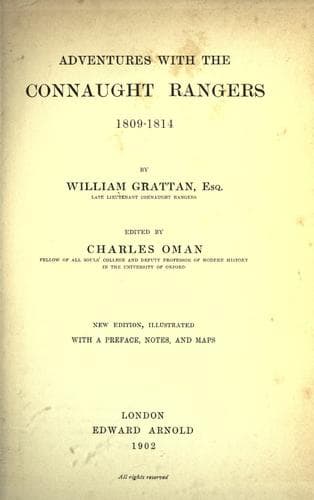
Adventures with the Connaught Rangers, 1809-1814Grattan, William
History
Adventures with the Connaught Rangers, 1809-1814
Grattan, William
Great Britain. Army. Regiment of Foot, 88th (Connaught Rangers); Peninsular War, 1807-1814 -- Personal narratives
These opinions are, however, mere matter of fancy. Some of our best
regiments were English, and one, to please me, decidedly the finest in
the Peninsular army, the 43rd, was principally composed of Englishmen.
Then there was that first-rate battle regiment, the 45th, a parcel of
Nottingham weavers, whose sedentary habits would lead you to suppose
they could not be prime marchers; but the contrary was the fact, and
they marched to the full as well as my own corps, which were all Irish
save three or four. But if it come to a hard tug, and that we had
neither rations nor shoes, then, indeed, the Connaught Rangers would be
in their element, and outmarch almost any battalion in the service; and
for this plain reason, that scarcely one of them wore many pairs of
shoes prior to the date of his enlistment, and as to the rations (the
most part of them at all events), a dozen times had been in all
probability the _outside_ of their acquaintance with such delicacies.
But the grand secret in a good marching, good fighting, or loyal
regiment, one not given to a habit of deserting, is being _well
commanded_; because the finest body of men may be ruined, the efforts of
the bravest regiment paralysed, and the best disposed corps become
marauders and deserters, from having an inefficient man at their head.
Colonel Alexander Wallace, who commanded us for so many years, and under
whom the regiment repeatedly covered itself with glory, was the very
chief we wanted. Although a Scotchman himself, he was intimately
acquainted with the sort of men he had under him, and he dealt with them
and addressed their feelings in a way that was peculiar to himself and
suited to them. In action he was the same as on parade, and in either
case he was as he should be. If we were placed (as we often were) in any
critical situation, he would explain to the soldiers what he expected
them to do; if in danger of being charged by cavalry he would say, “Mind
the square; you know I often told you that if ever you had to form it
from line, in face of an enemy, you’d be in a d—--d ugly way, and have
plenty of noise about you; mind the tellings off, and don’t give the
_false touch_ to your right or left hand man; for by G—d, if you are
once broken, you’ll be running here and there like a parcel of
_frightened pullets_!” But Colonel Wallace was out of his place as a
mere commander of a regiment; he was eminently calculated to head a
division, because he not only possessed that intrepidity of mind which
would brave any danger, but genius to discover the means of overcoming
it. It was by his foresight that our brave companions, the 45th, were
sustained in their unequal contest with Reynier’s division at Busaco;
and Lord Wellington, who saw and fully appreciated the manœuvre, rode
up to the 88th Regiment, and seizing Colonel Wallace by the hand, said:
“Upon my honour, Wallace, I never witnessed a more gallant charge than
that just now made by your regiment.” The dead and wounded of the 2nd
Public-domain text, read in full here on John Shaqi.
Reviews
Reviews
No reviews yet
Be the first to share your thoughts on this work.
Elsewhere in the archive
Join the Discussion
Join the discussion
Sign in to leave a comment or review.
Sign InorCreate an account