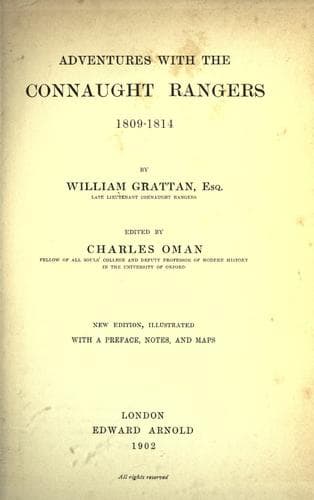
Adventures with the Connaught Rangers, 1809-1814Grattan, William
History
Adventures with the Connaught Rangers, 1809-1814
Grattan, William
Great Britain. Army. Regiment of Foot, 88th (Connaught Rangers); Peninsular War, 1807-1814 -- Personal narratives
and 4th Léger, the 15th and 36th (four French regiments which were
opposed to the 88th singly), lay thick on the face of the hill, and
their numbers gave ample testimony that we deserved the praises bestowed
upon us by our General. The 45th also came in for their share of praise,
and no battalion ever merited it better than they did;—at one time they
were engaged with nearly ten times their own number.
It was the fashion with some to think that the 88th were a parcel of
wild rattling rascals, ready for a row, but loosely officered. The
direct contrary was the fact. Perhaps in the whole British army there
was not one regiment so severely drilled. If a man coughed in the ranks,
he was punished; if the sling of the firelock, for an instant, left the
hollow of the shoulder when it should not, he was punished; and if he
moved his knapsack when standing at ease, he was punished—more or less
of course, according to the offence. The consequence of this system,
exclusively Colonel Wallace’s, was that the men never had the appearance
of being fatigued upon a march; and when they halted, you did not see
them thrusting their firelocks against their packs to support them. Poor
Bob Hardyman of the 45th said the reason the Connaught Rangers carried
their packs better than any other regiment was “that they never had
anything in them”! and, to speak candidly, we never had more than was
necessary, and in truth it was very little that satisfied our fellows.
At drill our manœuvres were chiefly confined to line marching,
echelon movements, and formation of the square in every possible way;
and in all these we excelled. Colonel Wallace was very unlike an old
Major who, having once got his battalion _into_ square, totally forgot
how to get it _out_ of it. Having tried several ways, each time more
effectually clubbing the sections, he thus addressed his officers and
soldiers: “Gentlemen! I can clearly discern that there is a _something
wanting_, and I strongly recommend you, when you reach your barracks, to
peruse Dundas![14]—Men, you may go home,” and he thus dismissed them.
-----
Footnote 14:
“Dundas” is the famous drill-book of Sir David Dundas, who succeeded
the Duke of York as Commander-in-Chief.
-----
Public-domain text, read in full here on John Shaqi.
Reviews
Reviews
No reviews yet
Be the first to share your thoughts on this work.
Elsewhere in the archive
Join the Discussion
Join the discussion
Sign in to leave a comment or review.
Sign InorCreate an account