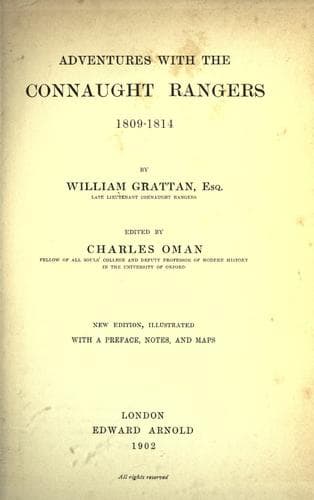
Adventures with the Connaught Rangers, 1809-1814Grattan, William
History
Adventures with the Connaught Rangers, 1809-1814
Grattan, William
Great Britain. Army. Regiment of Foot, 88th (Connaught Rangers); Peninsular War, 1807-1814 -- Personal narratives
There is no duty which a British soldier performs before an enemy that
he does with so much reluctance—a retreat always excepted—as working in
trenches. Although essentially necessary to the accomplishment of the
most gallant achievement a soldier can aspire to—the storming a
breach—it is an inglorious calling; one full of danger, attended with
great labour, and, what is even worse, with a deal of annoyance; and for
this reason, that the soldiers are not only taken quite out of their
natural line of action, but they are, if not entirely, at least
partially, commanded by officers, those of the Engineers, whose habits
are totally different from what they have been accustomed to.
No two animals ever differed more completely in their propensities than
the British engineer and the British infantry soldier. The latter
delights in an open field, and a fair “stand-up fight,” where he meets
his man or men (for numbers, when it comes to a hand-to-hand business,
are of little weight with the British soldier); if he falls there, he
does so, in the opinion of his comrades, with credit to himself; but a
life lost in the trenches is looked upon as one thrown away and lost
ingloriously. The engineer, on the contrary, braves all the dangers of a
siege with a cheerful countenance; he even courts them, and no mole ever
took greater delight in burrowing through a sandhill than an engineer
does in mining a covered way, or blowing up a counterscarp. Not so with
the infantry soldier, who is obliged to stand to be shot at, with a
pick-axe or shovel in his hand instead of his firelock and bayonet. If,
then, this is a trying situation, as it unquestionably is for a soldier,
where death by round-shot and shell in the works is comparatively less
than it is at the moment of the assault of a breach, how much more care
should there be taken in the selection of the ladder men than appears to
have been the case at San Christoval?
On the 22nd of June, the two French Marshals moved a large body of
troops towards Elvas and Campo Mayor, in order to cover their
_reconnoissance_ of our position. Our army at this time counted about
sixty-six thousand men, of which number only six thousand were cavalry.
The combined French army exceeded us by about ten thousand, and in the
arm of horse they were upwards of three thousand our superiors.
Notwithstanding this disproportion of force, Lord Wellington had made
able dispositions to beat the French Marshals in detail, and there is
little or no doubt but that he would have succeeded, had Marmont been
acting in concert with a man as presumptuous as himself; but Soult was
too good a judge not to see the sort of adversary he was opposed to, and
it was not possible to entrap him. Albuera taught him a lesson.
Public-domain text, read in full here on John Shaqi.
Reviews
Reviews
No reviews yet
Be the first to share your thoughts on this work.
Elsewhere in the archive
Join the Discussion
Join the discussion
Sign in to leave a comment or review.
Sign InorCreate an account