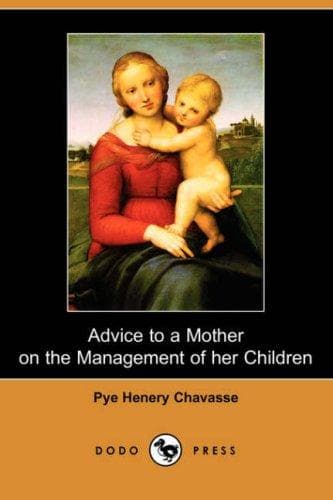
Advice to a Mother on the Management of Her ChildrenChavasse, Pye Henry
Science
Advice to a Mother on the Management of Her Children
Chavasse, Pye Henry
Child care; Children -- Health and hygiene; Infants -- Health and hygiene
I do, if the arrangements be such that health is preferred before
learning. [Footnote: "According to Aristotle, more care should be
taken of the body than of the mind for the first seven years; strict
attention to diet be enforced, &c. . . . . . The eye and ear of the
child should be most watchfully and severely guarded against
contamination of every kind, and unrestrained communication with
servants be strictly prevented. Even his amusements should be under
due regulation, and rendered as interesting and intellectual as
possible."--The Rev John Williams, in his _Life and Actions of
Alexander the Great_] Let children be only confined for three or four
hours a day, and let what little they learn be taught as an amusement
rather than as a labour. A play-ground ought to be attached to an
infant school; where, in fine weather, for every half-hour they spend
in-doors, they should spend one in the open air; and, in wet weather,
they ought to have, in lieu of the play-ground, a large room to romp,
and shout, and riot in. To develop the different organs, muscles, and
other parts of the body, children require fresh air, a free use of
their lungs, active exercise, and their bodies to be thrown into all
manner of attitudes. Let a child mope in a corner, and he will become
stupid and sickly. The march of intellect, as it is called, or rather
the double quick march of intellect, as it should be called, has
stolen a march upon health. Only allow the march of intellect and the
march of health to take equal strides, and then we shall have "_mens
sana in corpore sano_" (a sound mind in a sound body).
In the education of a young child, it is better to instruct him by
illustration, by pictures, and by encouraging observation on things
around and about him, than by books. It is surprising how much,
without endangering his health, may be taught in this way. In
educating your child, be careful to instil and to form good
habits--they will then stick to him for life.
Children at the present day are too highly educated--their brains are
over-taxed, and thus weakened. The consequence is, that as they grow
up to manhood, if they grow up at all, they become fools! _Children_
are now taught what formerly _youths_ were taught. The chord of a
child's life is ofttimes snapped asunder in consequence of over
education:--
"Screw not the cord too sharply, lest it snap"--_Tennyson_.
You should treat a child as you would a young colt. Think only at
first of strengthening his body. Let him have a perfectly free, happy
life, plenty of food to eat, abundance of air to breathe, and no work
to do; there is plenty of time to think of his learning--of giving him
brain work. It will come sadly too soon; but do not make him old
before his time.
182. _At what age do you advise my child to begin his course of
education--to have his regular lessons_?
Public-domain text, read in full here on John Shaqi.
Reviews
Reviews
No reviews yet
Be the first to share your thoughts on this work.
Elsewhere in the archive
Join the Discussion
Join the discussion
Sign in to leave a comment or review.
Sign InorCreate an account