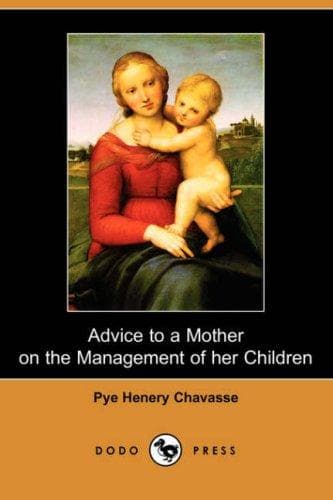
Advice to a Mother on the Management of Her ChildrenChavasse, Pye Henry
Science
Advice to a Mother on the Management of Her Children
Chavasse, Pye Henry
Child care; Children -- Health and hygiene; Infants -- Health and hygiene
The "nit"--the egg of the louse--might be distinguished from scurf
(although to the _naked_ eye it is very much like it in appearance) by
the former fastening firmly on one of the hairs as a barnacle would on
a rock, and by it not being readily brushed off as scurf would, which
latter (scurf) is always loose.
259. _My child, in the summer time, is much tormented with fleas: what
are the best remedies_?
A small muslin bag, filled with camphor, placed in the cot or bed,
will drive fleas away. Each flea-bite should, from time to time, be
dressed by means of a camel's hair brush, with a drop or two of Spirit
of Camphor; an ounce bottle of which ought, for the purpose, to be
procured from a chemist. Camphor is also an excellent remedy to
prevent bugs from biting. Bugs and fleas have a horror of camphor; and
well they might, for it is death to them!
There is a famous remedy for the destruction of fleas manufactured in
France, entitled "_La Poudre Insecticide,_" which, although perfectly
harmless to the human economy, is utterly destructive to fleas. Bugs
are best destroyed either by Creosote or by oil of Turpentine: the
places they do love to congregate in should be well saturated by means
of a brush, with the creosote or with the oil of turpentine. A few
dressings will effectually destroy both them and their young ones.
260. _Is not the pulse a great sign either of health or of disease_?
It is, and every mother should have a general idea of what the pulse
of children of different ages should be both in health and in
disease. "Every person should know how to ascertain the state of the
pulse in health; then, by comparing it with what it is when he is
ailing, he may have some idea of the urgency of his case. Parents
should know the healthy pulse of each child, since now and then a
person is born with a peculiarly slow or fast pulse, and the very case
in hand may be of such peculiarity. An infant's pulse is 140, a child
of seven about 80, and from 20 to 60 years it is 70 beats a minute,
declining to 60 at fourscore. A healthful grown person beats 70 times
in a minute, declining to 60 at fourscore. At 60, if the pulse always
exceeds 70, there is a disease; the machine working itself out, there
is a fever or inflammation somewhere, and the body is feeding on
itself, as in consumption, when the pulse is quick."
261. _Suppose a child to have had an attack either of inflammation of
the lungs or of bronchitis, and to be much predisposed to a return:
what precautions would you take to prevent either the one or the other
for the future_?
Public-domain text, read in full here on John Shaqi.
Reviews
Reviews
No reviews yet
Be the first to share your thoughts on this work.
Elsewhere in the archive
Join the Discussion
Join the discussion
Sign in to leave a comment or review.
Sign InorCreate an account