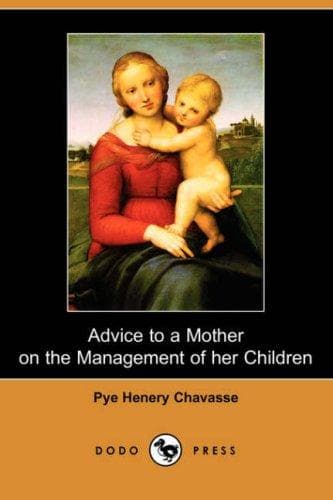
Advice to a Mother on the Management of Her ChildrenChavasse, Pye Henry
Science
Advice to a Mother on the Management of Her Children
Chavasse, Pye Henry
Child care; Children -- Health and hygiene; Infants -- Health and hygiene
Never kill a dog supposed to be mad who has bitten either a child, or
any one else, until it has, past all doubt, been ascertained whether
he be really mad or not. He ought, of course, to be tied up; and be
carefully watched, and be prevented the while from biting any one
else. The dog by all means should be allowed to live at least for some
weeks, as the fact of his remaining well will be the best guarantee
that there is no fear of the bitten child having caught hydrophobia.
There is a foolish prejudice abroad, that a dog, be he mad or not, who
has bitten a person ought to be _immediately_ destroyed; that although
the dog be not at the time mad, but should at a future period become
so, the person who had been bitten when the dog was _not_ mad, would,
when the dog became mad, have hydrophobia! It seems almost absurd to
bring the subject forward; but the opinion is so very general and
deep-rooted, that I think it well to declare that there is not the
slightest foundation of truth in it, but that it is a ridiculous
fallacy!
A cat sometimes goes mad, and its bite may cause hydrophobia; indeed,
the bite of a mad cat is more dangerous than the bite of a mad dog. A
bite from a mad cat ought to be treated precisely in the same
manner-namely, with the lunar-caustic--as for a mad dog.
Hydrophobia was by our forefathers graphically called _water-fright_:
it was well named, for the horror of swallowing water is, by an
hydrophobic patient, most intense, and is _the_ leading symptom of
this fell and incurable disease.
A bite either from a dog or from a cat _who is not mad_, from a cat
especially, is often venomous and difficult to heal. The best
application is, _immediately_ to apply a large hot white bread
poultice to the part, and to renew it every four hours; and, if there
be much pain in the wound, to well foment the part, every time before
applying the poultice, with a hot camomile and poppy-head fomentation.
Scratches of a cat are best treated by smearing, and that freely and
continuously for an hour, and then afterwards at longer intervals,
fresh butter on the part affected. If fresh butter Be not at hand,
fresh lard--that is to say, lard _without_ salt--will answer the
purpose. If the pain of the scratch be very intense, foment the part
affected with hot water, and then apply a hot white bread poultice,
which should be frequently renewed.
297. _What are the best remedies in ease of a sting from either a bee
or a wasp_?
Public-domain text, read in full here on John Shaqi.
Reviews
Reviews
No reviews yet
Be the first to share your thoughts on this work.
Elsewhere in the archive
Join the Discussion
Join the discussion
Sign in to leave a comment or review.
Sign InorCreate an account