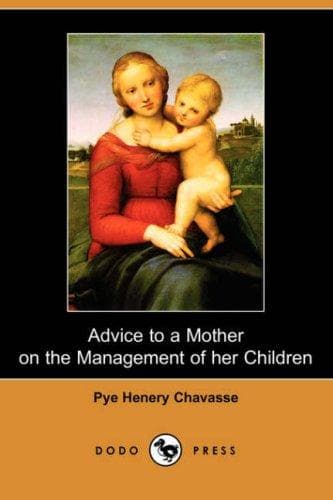
Advice to a Mother on the Management of Her ChildrenChavasse, Pye Henry
Science
Advice to a Mother on the Management of Her Children
Chavasse, Pye Henry
Child care; Children -- Health and hygiene; Infants -- Health and hygiene
There is usually hoarseness, not constant, but coming on if the
patient be tired, or towards the evening; there is also a sense of
lassitude and depression, shortness of breath, a feeling of being
quickly wearied--more especially on the slightest exertion. The hair
of a consumptive person usually falls off, and what little remains is
weak and poor; the joints of the fingers become enlarged, or clubbed
as it is sometimes called; the patient loses flesh, and, after some
time, night sweats make their appearance: then we may know that hectic
fever has commenced.
Hectic begins with chilliness, which is soon followed by flushings of
the face, and by burning heat of the hands and the feet, especially of
the palms and the soles. This is soon succeeded by perspirations. The
patient has generally, during the day, two decided paroxysms of hectic
fever--the one at noon, which lasts above five hours; the other in the
evening, which is more severe, and ends in violent perspirations,
which perspirations continue the whole night through. He may, during
the day, have several attacks of hectic flushes of the face,
especially after eating; at one moment he complains of being too hot,
and rushes to the cool air; the next moment he is too cold, and almost
scorches himself by sitting too near the fire. Whenever the
circumscribed hectic flush is on the cheek, it looks as though the
cheek had been painted with vermilion, then is the time when the palms
of the hands are burning hot. Crabbe, in the following lines,
graphically describes the hectic flush:--
"When his thin cheek assumed a deadly hue,
And all the rose to one small spot withdrew:
They call'd it hectic; 'twas a fiery flush,
More fix'd and deeper than the maiden blush."
The expectoration at first is merely mucus, but after a time it
assumes a characteristic appearance; it has a roundish, flocculent,
woolly form, each portion of phlegm keeping, as it were, distinct; and
if the expectoration be stirred in water, it has a milk-like
appearance. The patient is commonly harassed by frequent bowel
complaints, which rob him of what little strength he has left. The
feet and ankles swell. The perspiration, as before remarked, comes on
in the evening, continues all night--more especially towards morning,
and while the patient is asleep; during the time he is awake, even at
night, he seldom sweats much. The thrush generally shows itself
towards the close of the disease, attacking the tongue, the tonsils,
and the soft palate, and _is a sure harbinger of approaching
death_. Emaciation rapidly sets in.
Public-domain text, read in full here on John Shaqi.
Reviews
Reviews
No reviews yet
Be the first to share your thoughts on this work.
Elsewhere in the archive
Join the Discussion
Join the discussion
Sign in to leave a comment or review.
Sign InorCreate an account