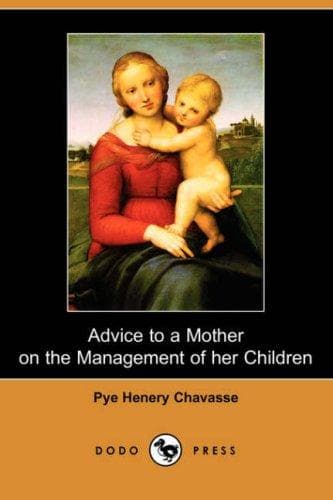
Advice to a Mother on the Management of Her ChildrenChavasse, Pye Henry
Science
Advice to a Mother on the Management of Her Children
Chavasse, Pye Henry
Child care; Children -- Health and hygiene; Infants -- Health and hygiene
The treatment which would prevent should be adopted when the complaint
first makes its appearance. If the above means do not quickly remove
it, the mother must then apply to a medical man, and he will give
medicines _which will soon have the desired effect_. Chlorosis is very
amenable to treatment. If the disease be allowed for any length of
time to run on, it may produce either organic--incurable--disease of
the heart, or consumption or indigestion, or confirmed ill-health.
391. _At what period of life is a lady most prone in Hysterics, and
what are the symptoms_?
The time of life when hysterics occur is generally from the age of
fifteen to fifty. Hysterics come on by paroxysms--hence they are
called hysterical fits. A patient, just before an attack, is
low-spirited; crying without a cause; she is "nervous," as it is
called; she has flushings of the face; she is at other times very
pale; she has shortness of breath and occasional palpitations of the
heart; her appetite is usually bad; she passes quantities of
colourless limpid urine, having the appearance of pump water; she is
much troubled with flatulence in her bowels, and, in consequence, she
feels bloated and uncomfortable. The "wind" at length rises upwards
towards the stomach, and still upwards to the throat, giving her the
sensation of a ball stopping her breathing, and producing a feeling of
suffocation. The sensation of a ball in the throat (_globus
hystericus_) is the commencement of the fit.
She now becomes _partially_ insensible, although she seldom loses
_complete_ consciousness. Her face becomes flushed, her nostrils
dilated, her head thrown back, and her stomach and bowels enormously
distended with "wind." After a short time she throws her arms and her
legs about convulsively, she beats her breast, tears her hair and
clothes, laughs boisterously and screams violently; at other times she
makes a peculiar noise; sometimes she sobs and her face is much
distorted. At length she brings up enormous quantities of wind; after
a time she bursts into a violent flood of tears, and then gradually
comes to herself.
As soon as the fit is at an end she generally passes enormous
quantities of colourless limpid urine. She might, in a short time,
fall into another attack similar to the above. When she comes to
herself she feels exhausted and tired, and usually complains of a
slight headache, and of great soreness of the body and limbs. She
seldom remembers what has occurred during the fit. Hysterics are
sometimes frightful to witness, but, in themselves, are not at all
dangerous.
Hysterics--an hysterical fit--is sometimes styled hysterical
passion. Shakspeare, in one of his plays, calls it _hysterica
passio_--
"Oh how this, mother, swells up toward my Heart! _Hysterica
passio!_"
Sir Walter Scott graphically describes an attack--"The hysterical
passion that impels tears is a terrible violence--a sort of throttling
sensation--then succeeded by a state of dreaming stupidity"
Public-domain text, read in full here on John Shaqi.
Reviews
Reviews
No reviews yet
Be the first to share your thoughts on this work.
Elsewhere in the archive
Join the Discussion
Join the discussion
Sign in to leave a comment or review.
Sign InorCreate an account