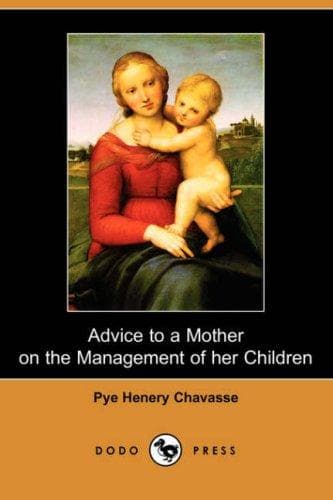
Advice to a Mother on the Management of Her ChildrenChavasse, Pye Henry
Science
Advice to a Mother on the Management of Her Children
Chavasse, Pye Henry
Child care; Children -- Health and hygiene; Infants -- Health and hygiene
Now, suppose the dysentery has for several days persisted, and that,
during that time, nothing but mucus and blood--that no real stool--has
come from the bowels, then a combination of castor oil and opium
[Footnote: My friend, the late Dr Baly, who had made dysentery his
particular study, considered the combination of opium and castor oil
very valuable in dysentery.] ought, instead of the medicine
recommended above, to be given:--
Take of--Mucilage of Gum Acacia, three drachms;
Simple Syrup, three drachms;
Tincture of Opium, ten drops (_not_ minims);
Castor Oil, two drachms;
Cinnamon water, four drachms:
Make a Mixture. A tea spoonful to be taken every four hours, first
_well_ shaking the bottle.
A warm bath, at the commencement of the disease, is very efficacious;
but it must be given at the _commencement_. If he has had dysentery
for a day or two, he will be too weak to have a warm bath; then,
instead of the bath, try the following:--Wrap him in a blanket, which
has been previously wrung out of hot water; over which envelope him in
a _dry_ blanket. Keep him in this hot, damp blanket for half an hour;
then take him out, put on his nightgown and place him in bed, which
has been, if it be winter time, previously warmed. The above "blanket
treatment" will frequently give great relief, and will sometimes cause
him to fall into a sweet sleep. A flannel bag, filled with hot
powdered table salt, made hot in the oven, applied to the bowels, will
afford much comfort.
_What NOT to do_.--Do not give aperients unless it be, as before
advised, the castor oil guarded with the opium; do not stuff him with
artificial food; do not fail to send for a judicious and an
experienced medical man; for, remember, it requires a skilful doctor
to treat a case of dysentery, more especially in a child.
105. _What are the symptoms, the causes and the treatment of
Nettle-rash_?
Nettle-rash consists of several irregular, raised wheals, red at the
base, and white on the summit, on different parts of the body; _but it
seldom attacks the face_. It is not contagious, and it may occur at
all ages and many times. It comes and goes, remaining only a short
time in a place. It puts on very much the appearance of the child
having been stung by nettles--hence its name. It produces great heat,
itching, and irritation, sometimes to such a degree as to make him
feverish, sick, and fretful. He is generally worse when he is warm in
bed, or when the surface of his body is suddenly exposed to the air.
Rubbing the skin, too, always aggravates the itching and the tingling,
and brings out a fresh crop.
The _cause_ of nettle-rash may commonly be traced to improper feeding;
although, occasionally, it proceeds from teething.
Public-domain text, read in full here on John Shaqi.
Reviews
Reviews
No reviews yet
Be the first to share your thoughts on this work.
Elsewhere in the archive
Join the Discussion
Join the discussion
Sign in to leave a comment or review.
Sign InorCreate an account