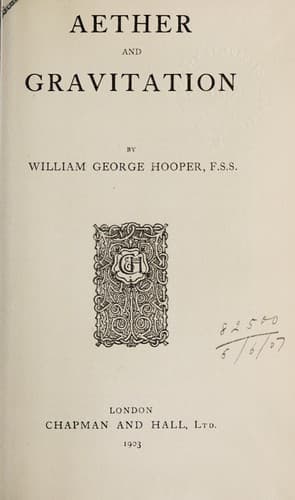
Ether (Space); Force and energy; Gravitation; Matter
conservation of all modes of motion, as motion cannot be destroyed, it
must therefore be perpetual.
It is an absolute impossibility to obtain motion except from some
antecedent energy, which is itself a form of motion. It would require
the distinctive fiat of an Almighty Creator to produce motion from
nothing, and I question whether such a result is obtainable, as I hold
that if the Creator, at any time in the history of the universe, set any
substance in motion, the source from which that motion was derived, was
His own Divine Energy, and in that sense the physical motion was not
produced from nothing. Such an assumption is altogether opposed to all
philosophical reasoning and experience. I hope to deal with the question
either in the last chapter of this book, or in another work.
ART. 58. _Transformation of Motion._--Again, if energy be the energy of
motion, and the principle of the transformations of energy holds good,
then it is equally true that all modes of motion are also transformable.
Thus heat is a mode of motion, being due to the vibration of the atoms
which go to make up any body. Light is also a mode of motion, being due,
as far as solar light is concerned, to the periodic wave motion of the
Aether. While electricity, as we shall see later on, is also due to some
form of rotatory motion. It has already been shown (Art. 54) that light
can be converted into heat, so that the periodic wave motion of light
can be transformed into the vibratory motion of heat.
Heat can also be converted into electricity, and if electricity be
rotatory motion, then the vibratory motion of heat can be transformed
into the rotatory motion of electricity. Again, as electricity can be
converted into light, the rotatory motion of electricity can thus be
transformed into the periodic wave motion of light. Thus through all the
forms of motion with which we are familiar, we find this principle of
transformation holds good, so that each form of motion may be directly
or indirectly transformed into any one of the other kinds. Whenever,
therefore, one kind of motion disappears, it is absolutely necessary,
according to the principle of the conservation of motion, that some
other kind shall be produced. There cannot be any real loss or
destruction of the motion. It may be transformed, but not lost. By the
use of proper apparatus, therefore, any form of motion with which we are
familiar may be converted into another form, and in the process not the
least quantity of any form of motion is lost. Heat may be changed into
light, and light into heat; electricity into light, and light into
electricity; heat into electricity, and electricity into heat. Indeed,
starting from any one form, any of the other modes of motion may be
produced, either directly or indirectly, and mechanical effects or work
may be produced by each and all. Then, again, the order can be reversed,
as by doing work which is simply applied motion, any of the other modes
of motion can be produced.
Public-domain text, read in full here on John Shaqi.
Reviews
Reviews
No reviews yet
Be the first to share your thoughts on this work.
Elsewhere in the archive
Join the Discussion
Join the discussion
Sign in to leave a comment or review.
Sign InorCreate an account