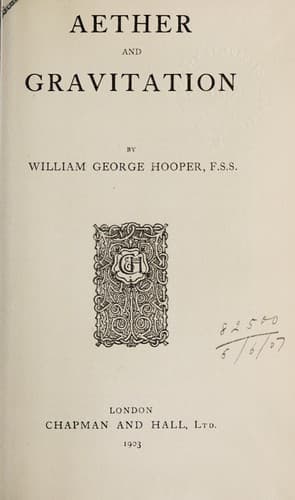
Ether (Space); Force and energy; Gravitation; Matter
Sir John Herschel found that the heating power of the sun when it was
directly overhead was capable of melting .00754 of an inch of ice per
minute. According to M. Pouillet the quantity was .00703 of an inch,
which is equal to about half-an-inch per hour. From these results it has
been calculated that if the direct heat of the sun were received upon a
block of ice one mile square, 26,000 tons would be melted per hour by
the heat which would be absorbed. Again, as Herschel[12] puts it:
"Supposing a cylinder of ice, 45 miles in diameter, to be continually
darted into the sun with the velocity of light, the heat given off
constantly from the sun by radiation would be wholly expended in
liquefaction on the one hand, while on the other, the actual temperature
at the sun's surface would undergo no diminution." Sir John Herschel
further says: "All the heat we enjoy comes from the sun. Imagine the
heat we should have to endure if the sun were to approach us, or we the
sun, to a point the one hundred and sixtieth part of the present
distance. It would not be merely as if 160 suns were shining on us all
at once, but 160 times 160 suns according to the rule of inverse
squares--that is, 25,600. Imagine a globe emitting heat 25,600 times
fiercer than that of an equatorial sunshine at noonday, with the sun
vertical. In such a heat there is no solid substance we know of which
would not run like water, boil, or be converted into smoke or vapour."
Lockyer points out that the heat radiated from every square yard of the
sun's surface is equal to the amount of heat produced by the burning of
six tons of coal on that area in one hour. Now the surface of the sun
may be estimated at 2,284,000,000,000 square miles, and there are
3,097,600 square yards in each square mile; what therefore must be the
number of tons of coal which must be burnt per hour to represent the
amount of heat radiated from the sun into space? The approximate result
may be calculated by multiplication, but the figures arrived at fail to
give any adequate conception of the actual result.
Public-domain text, read in full here on John Shaqi.
Reviews
Reviews
No reviews yet
Be the first to share your thoughts on this work.
Elsewhere in the archive
Join the Discussion
Join the discussion
Sign in to leave a comment or review.
Sign InorCreate an account