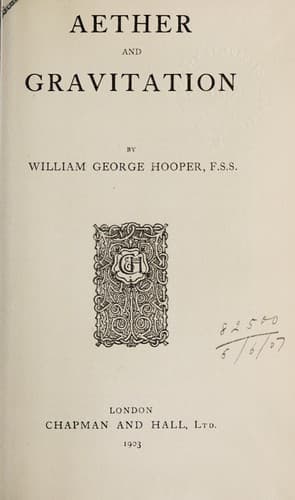
Ether (Space); Force and energy; Gravitation; Matter
So that in all three theories we have the same fundamental idea of
atoms, either expressed or imagined, underlying all the three theories.
Now what is the property of the Aether on which all reflection and
refraction is based? Is it not the property of density? Fresnel assumes
that reflection and refraction of light are dependent upon different
degrees of density of the Aether associated with any body, and has given
a mathematical formula, which decides the index of refraction, such
formula being entirely dependent upon the relative density of the Aether
in association with the refracting medium.
But with a frictionless medium, it is an absolute impossibility to
conceive of different degrees of density of the Aether in association
with matter.
If the Aether does possess different degrees of density which decide the
refractive index of the substance, then of a certainty there must be
some law to govern and decide the density, and that law can only be the
Law of Gravitation.
As Young points out in his Fourth Hypothesis, every particle of matter
has an attraction for the Aether by which it is accumulated around it
with greater density. Now on the basis of our conception of a
gravitative Aether, every atom and molecule, and indeed every body in
the universe, possess aetherial atmospheres, which possess varying
degrees of density, the denser layers being nearest to the nucleus of
the atom or molecule as the case may be, the elasticity of each layer or
envelope being always proportionate to its density.
When we apply the corpuscular theory to the reflection of light we find
that it satisfactorily accounts for the phenomenon.
According to Newton's corpuscular theory, each luminous particle travels
in a straight line through a homogeneous medium. When, however, it comes
almost into contact with a reflecting surface, which in our case we
conceive to be a layer of one of the aetherial elastic envelopes
surrounding the atoms or molecules of the reflecting body, then,
according to Newton, the light particle is repelled, or reflected by the
medium; the angle of reflection or repulsion being always equal to the
angle of incidence. So that the emission theory harmonizes with the wave
theory in regard to reflection.
When, however, we come to deal with the refraction of light, the
corpuscular theory apparently breaks down, and it was in relation to
this phase of the phenomena of light that the undulatory theory
overthrew the corpuscular theory.
Public-domain text, read in full here on John Shaqi.
Reviews
Reviews
No reviews yet
Be the first to share your thoughts on this work.
Elsewhere in the archive
Join the Discussion
Join the discussion
Sign in to leave a comment or review.
Sign InorCreate an account