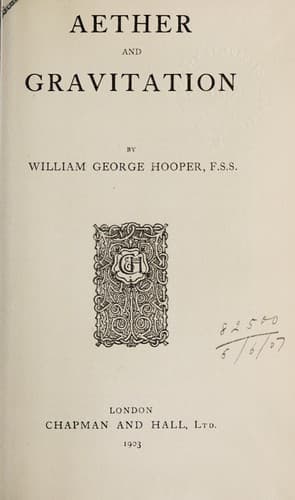
Ether (Space); Force and energy; Gravitation; Matter
There is another difficulty that the emission theory had to contend
with, and that was, how was it possible for the same surface of any
substance to reflect and refract a corpuscle at one and the same time?
Newton overcame this difficulty by suggesting, from the results of his
observations on certain coloured rings, that each particle had what he
called certain phases or fits, of easy reflection or refraction, so that
at certain times they would be refracted, and at other times they would
be reflected.
Boscovitch has suggested that the fits were due to the fact that each
luminous corpuscle possessed polarity; which, by rotating, alternately
offered their different sides to the refractive and reflecting surfaces,
so that sometimes they would be reflected or repelled, and at other
times attracted or refracted.
A similar hypothesis has also been suggested by Biot. Now if such a
hypothesis will satisfactorily account for the fact that the same medium
will reflect or refract the luminous corpuscles, as the case may be,
then in our aetherial atom we have the very conditions which would
satisfy both Boscovitch and Biot's hypothesis. For one of the properties
that we suggested regarding our aetherial atom was, that it possessed
rotation like our own earth, and that it also possessed polarity.
The harmonizing of the two theories, therefore, seems to rest upon the
atomicity or non-atomicity of the Aether.
It is absolutely certain that the electro-magnetic theory of light
demands the recognition of some form of atomicity for the Aether. For if
light be really an electro-magnetic phenomena, as has been proved by
Maxwell and experimentally demonstrated by Hertz, then, in view of the
fact that the atomicity of electricity is coming within the scope of
direct experiment as asserted by Dr. Larmor, unless we accept atomicity
of the Aether in some way, we shall be in the unphilosophical position
of having the Aether of space not being composed of atoms, while the
electricity associated with that Aether in some unknown way is composed
of atoms. In other words, we shall have a non-atomic body composed of
atoms, which conclusion is absurd. Therefore, from the electro-magnetic
theory of light, we are again compelled to postulate atoms of some kind
for the Aether.
If there are electrical atoms in association with the Aether, then they
must be of two kinds, positive and negative, as it is impossible to find
positive electricity disassociated from negative. Therefore, from the
electro-magnetic theory of light we get further evidence of the polarity
of the aetherial atom, by which Newton's fits of easy reflection or
refraction may be physically conceived.
Public-domain text, read in full here on John Shaqi.
Reviews
Reviews
No reviews yet
Be the first to share your thoughts on this work.
Elsewhere in the archive
Join the Discussion
Join the discussion
Sign in to leave a comment or review.
Sign InorCreate an account