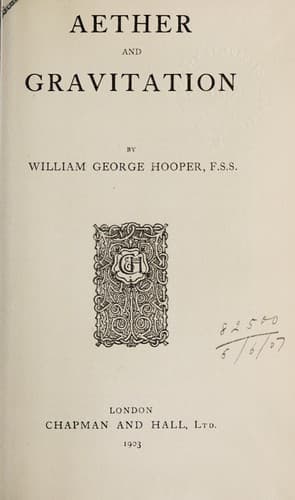
Ether (Space); Force and energy; Gravitation; Matter
So that on Mercury, which is pushed along by a denser electro-magnetic
Aether than Venus, the impressed force, according to Newton's Second Law
of Motion, will be greater than the impressed force exerted by the
moving electro-magnetic Aether on Venus; and, consequently, Mercury
should have a greater velocity through space than Venus, due partly to
the difference of the aetherial mass and density, by which the impressed
force or motive power that acts upon Mercury is produced.
In the same way, Venus should have a greater velocity through space than
Mars, and Mars a greater velocity than the Earth. The same principle, when
applied to the outer planets, equally holds good; with the result, that
the greater the mean distance, the less the orbital velocity of each
planet, due partly to the decreased aetherial density at the increased
distance from the sun. But this is only part of the cause. Not only is
there a decrease in density of the Aether, as the distance from the sun
is increased, but there is also a decrease in the velocity of the moving
Aether, with the result that the Aether at the distance of Mercury,
possesses a greater angular velocity than at the distance of Venus.
It may be at once asked, How do we know that? Well, Philosophy alone can
give us the key, and Philosophy tells us to base our theories and
hypotheses on experience and experiment. Now what does experiment and
experience teach us as to the effect of a body revolving in any medium
upon that medium? If experience teaches us anything at all, it teaches
us that the further away any medium is from the revolving body, the less
is the angular velocity of that medium at that distance, while the
nearer the medium is to the revolving body, the greater is the angular
velocity.
This applies in each and every case, whether the medium is either fluid
or gaseous, and I will challenge the reader to perform any experiment on
any solid body rotating in a fluid or gaseous medium, and prove by that
experiment that the angular velocity of the outermost part of the fluid
or gaseous medium is equal to the angular velocity of the medium
directly associated with the body, or even at a short distance from it.
But we have most conclusive evidence of the fact that a solid body does
not communicate all its rotational surface motion to the medium directly
in contact with that body in the case of the earth revolving on its
axis, surrounded by an atmosphere. If the principle held good anywhere
in relation to a revolving body, viz. that the whole of the rotational
velocity is communicated to the medium surrounding the body, it should
certainly hold good at the surface of the body where the two media, the
solid and gaseous media, meet.
Public-domain text, read in full here on John Shaqi.
Reviews
Reviews
No reviews yet
Be the first to share your thoughts on this work.
Elsewhere in the archive
Join the Discussion
Join the discussion
Sign in to leave a comment or review.
Sign InorCreate an account