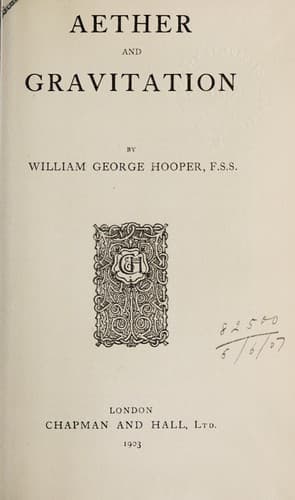
Ether (Space); Force and energy; Gravitation; Matter
Encke's ... 3-1/4 years. 32,000,000 miles. 387,000,000 miles.
De Vico's ... 5-1/2 " 110,000,000 " 475,000,000 "
Biela's ... 6-1/2 " 82,000,000 " 585,000,000 "
D'Arrest's ... 6-1/2 "
Faye's ... 7-1/2 " 192,000,000 " 603,000,000 "
Halley's ... 76-3/4 " 56,000,000 " 3,200,000,000 "
Encke's Comet was discovered by Professor Encke of Berlin, and named
after him. It revolves in an ellipse of great eccentricity, as proved by
the fact that when nearest to the sun, it is inside Mercury's orbit, but
when furthest away from the sun, it passes beyond the orbit of Mars,
reaching almost to the orbit of Jupiter. One of the most remarkable
facts about this comet is, that it has done more to establish the
existence of that resisting medium around the sun, whose existence we
have demonstrated, than any other comet. Encke found on its periodical
return that its mean distance was gradually getting less, and in order
to account for this, he supposed that it was due to the existence of a
resisting medium which enveloped the sun, and extended some distance
into space.
This conclusion has been supported in recent years by Von Asten, a
German mathematician, who has supported the theory of a resisting
medium. On this point Herschel writes in his _Outlines of Astronomy_,
Art. 577: "This is evidently the effect which would be produced by a
resistance experienced by the comet from a very rare aetherial medium
pervading the regions in which it moves; for such resistance, by
diminishing its actual velocity, would diminish its centrifugal force.
Accordingly, this is the solution proposed by Encke, and at present
generally received."
So that we have in Encke's Comet another proof of the existence of that
aetherial medium, which is not frictionless, but has the power to oppose
any body which moves through it, when that body moves in an opposite
direction to its own motions.
Another Short Period Comet worthy of notice is that of Biela, named
after M. Biela, its discoverer. This comet had a period of six and a half
years, and reappeared at several successive intervals until about the
year 1845, when it seems to have been broken or split up into two parts.
In December 1845 the comet divided into two parts, which travelled
parallel to each other for a long distance. During this separation, very
singular changes were observed to be taking place in both the original
comet and its offshoot.
Public-domain text, read in full here on John Shaqi.
Reviews
Reviews
No reviews yet
Be the first to share your thoughts on this work.
Elsewhere in the archive
Join the Discussion
Join the discussion
Sign in to leave a comment or review.
Sign InorCreate an account