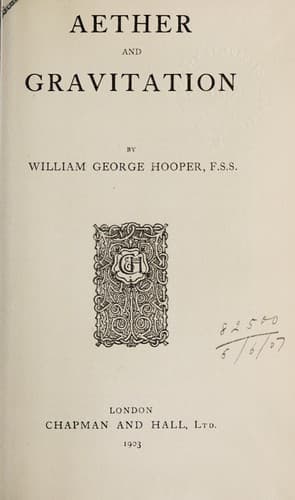
Ether (Space); Force and energy; Gravitation; Matter
The brightest stars of each constellation are named after the letters of
the Greek alphabet, the brightest being called Alpha, the next in
brilliancy Beta, and so on, right through the Greek alphabet. For
example, the seven stars in the Great Bear are known as Alpha, Beta,
Gamma, Delta, Epsilon, Zeta, and Eta.
The constellations are grouped into two divisions, known as the Northern
and Southern constellations respectively.
The visible Northern constellations are 25 in number, and include the
following well-known groups--
Ursa Major The Great Bear.
Ursa Minor The Little Bear.
Draco The Dragon.
Hercules Hercules.
Cygnus The Swan.
Lyra The Lyre.
The visible Southern constellations are 18 in number, and include such
groups as--
Cetus The Whale.
Orion Orion.
Canis Major The Great Dog.
Canis Minor The Little Dog.
Corona Australis The Southern Crown.
Crux Australis The Southern Cross.
_Variable Stars._--Not only are the stars of different magnitudes, but
the brilliancy of some of them changes from time to time. This class of
stars is known as variable stars, and has received the attention of
modern astronomers for many years, in order that the cause of their
variation might, if possible, be ascertained. The periods of variation
differ in length, ranging from a number of days to 60 or 70 years.
One of the most interesting of variable stars is that known as Omicron
Ceti, whose period of change is about 331 days. Its brilliancy varies
from one of the second magnitude to one of the tenth.
Beta Persei is another well-known variable star. This star shines as one
of the second magnitude for 2 days and 13 hours, and then suddenly loses
its light, and in less than 4 hours becomes a star of the fourth
magnitude. Its brilliancy then increases again, and in a similar time it
regains its former brilliancy.
The conclusion that has been arrived at in regard to the cause of the
variation of these stars is, that in each case the diminution of light
is due to the existence of dark bodies, probably planets, which revolve
round the central star.
This hypothesis was confirmed by Professor Vogel about 1889 by means of
spectroscopic results.
Another interesting fact about stars is that they shine with various
colours. The colours of stars are as various as the colours of the
rainbow, and range through the whole spectrum, of red, orange, yellow,
green, blue, indigo, violet, and white. What is more remarkable is the
fact that the colours of the stars seem to change through great periods
of time. If we turn to ancient records we learn that Sirius was red
then, but is now green, while Capella was also red, but is now pale
blue.
Public-domain text, read in full here on John Shaqi.
Reviews
Reviews
No reviews yet
Be the first to share your thoughts on this work.
Elsewhere in the archive
Join the Discussion
Join the discussion
Sign in to leave a comment or review.
Sign InorCreate an account