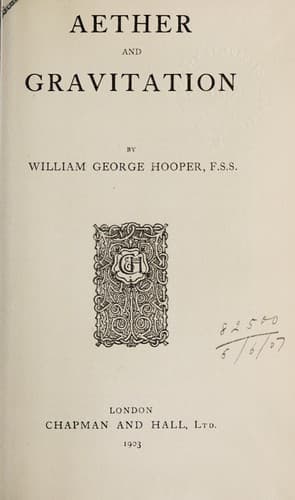
Ether (Space); Force and energy; Gravitation; Matter
The first rule dealt with the general simplicity of Nature's mode of
working, and therefore the general simplicity which must govern our
hypotheses in perfecting any theory as to the cause of all phenomena,
gravitational or otherwise.
The second rule showed that the only sound basis from whence we could
derive all our data upon which to speculate and reason, lay in our
experience of all natural phenomena. Whatever else we might do, or not
do, it was absolutely necessary, if we wished to be perfectly
philosophical in our conclusions, that we should not traverse the direct
results of observations and experiments.
The third rule laid down was the obvious axiom, that the theory so
perfected by logical reasoning must satisfactorily account for and
explain all the phenomena sought to be explained.
Now I wish to submit the whole theory as propounded in this work in its
completion and in its entirety to the reader, and to ask him if the
Rules of Philosophy have not been adhered to throughout the whole work?
Can any theory be more simple than the one submitted in this work, by
which we have endeavoured to account for all, and even more, than was
premised in the opening chapters?
The very simplicity of the fundamental hypothesis that Aether is matter,
in all its properties and qualities, has been the chief obstacle to the
retardation of its earlier discovery.
Any proposition more simple, more easy of comprehension, is, to my mind,
difficult of conception. Why, children in our homes and schools may be
taught the truth, and grasp it in its concrete form, and that is the
highest test of the simplicity of any hypothesis.
Thus the first Rule of Philosophy is satisfied and fulfilled in the
initial hypothesis, and I venture to affirm that the same simplicity has
characterized the development of the theory throughout its entire
progress. Step by step, simple facts and simple truths which are known
to any ordinary student have been shown to have a wider and more
universal application than even the writer dreamed of, when he started
out on his voyage of discovery in philosophical research.
When we consider the second Rule of Philosophy in its application to our
theory, we find that experience, as revealed by observation and
experiment, is fulfilled to the minutest detail. The simple hypothesis
that Aether is matter, fulfils to the very fullest extent all
requirements demanded by the experience of all the scientists and
experimentalists that the world has ever known. To assert that Aether is
not matter is to assert a proposition contrary to all the accumulated
experience of the past generations. Therefore, if Aether is matter, then
its fundamental qualities must be those which belong to and are
associated with all matter, those qualities being atomicity, gravity,
density, elasticity, inertia, and compressibility.
Public-domain text, read in full here on John Shaqi.
Reviews
Reviews
No reviews yet
Be the first to share your thoughts on this work.
Elsewhere in the archive
Join the Discussion
Join the discussion
Sign in to leave a comment or review.
Sign InorCreate an account