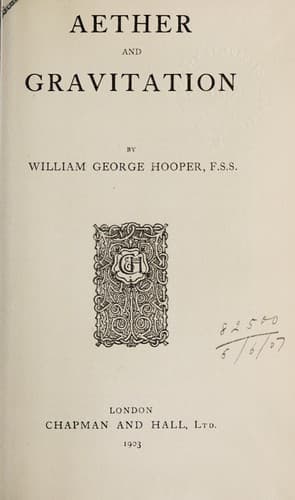
Ether (Space); Force and energy; Gravitation; Matter
After all, how much of this theory is there which is entirely new or
absolutely original? Age after age, men have had exactly similar dreams,
and seen similar visions. In the old Grecian days similar views were
expressed by their philosophers; and, even in the philosophy of less
civilized countries, many of the suggested hypotheses found their place
in a more or less perfect form.
Analyze the whole theory from its initial stages to the last chapter,
and we shall find, with the exception of one or two features, that every
hypothesis first had its origin in the mind of some of the greatest
thinkers and philosophers that the world has ever known.
Take several hypotheses as examples. The hypothesis that Aether is
atomic was suggested by such men as Newton, Huyghens, Descartes,
Challis, Clerk Maxwell, and others.
That Aether is gravitative has been suggested by Young, Grove, Faraday,
and Lord Kelvin. Huyghens, Fresnel, and Young postulated different
degrees of density for the Aether, while Stokes and McCullagh have
affirmed and proved different degrees of elasticity of the medium.
The inertia of the medium has received experimental evidence from
Tyndall, Maxwell, Faraday, Lodge, and others, and its compressibility
has received the adherence of men like Faraday, Maxwell, and Lord
Kelvin.
Then, when we come to deal with the causes of the forces involved in
gravitational phenomena, we find that exactly similar hypotheses in
regard to the Centrifugal Force have been postulated by Herschel,
Bredichin, M. Faye, and Lebedew; while Faraday, Gauss and others have
suggested the close relationship that exists between electrical and
gravitational phenomena.
The physical explanation of Kepler's Laws was suggested by Kepler
himself, while Huyghens, Bernoulli, Descartes, and many of their
contemporaries believed in the existence of some kind of vortices.
The unity of the universe has been a dream of philosophers for
generations past, and that dream is now crystallized in the definite
conception of an atomic universal electro-magnetic medium, while the
electrical basis of matter receives the support of such men as Crookes,
J. J. Thomson, Larmor and Vogt.
Thus we learn that all the dreams and thoughts, all the hypotheses and
postulates of old-world as well as present-day philosophers find their
consummation and ultimate realization in one universal, atomic,
electro-magnetic medium.
If this fact does not stamp the theory with that authority which is
undeniably associated with the names of some of the scientists quoted,
then all the greatest men in the scientific world have lived and toiled,
thought and dreamed in vain, while the priceless gems of their
imagination and research are treated as worthless and valueless.
Again, what shall we say of the discoveries of to-day?
Public-domain text, read in full here on John Shaqi.
Reviews
Reviews
No reviews yet
Be the first to share your thoughts on this work.
Elsewhere in the archive
Join the Discussion
Join the discussion
Sign in to leave a comment or review.
Sign InorCreate an account