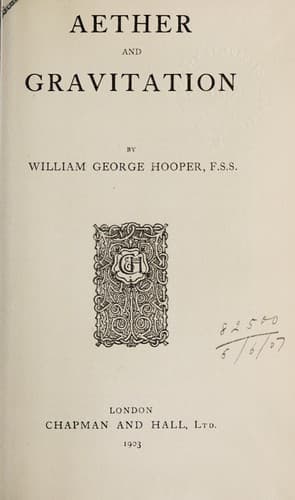
Ether (Space); Force and energy; Gravitation; Matter
In addition to this motion of the aetherial atmosphere through space,
there are other motions of this same gravitating Aether that have to be
taken into consideration, before a complete and adequate conception of
all the motions of the Aether can be arrived at.
I do not intend, however, at this stage to go fully into such motions,
but rather wish to lead up to them from a consideration of hypotheses
put forward by such men as Rankine, Challis, Maxwell, Lord Kelvin,
McCullagh, and Helmholtz, and from a consideration of such hypotheses in
the realm of heat, light, and electricity to be able to form a
scientific conception of the proper motions of the Aether, as well as a
philosophical one.
CHAPTER V
ENERGY
ART. 51. _Energy._--In the days of Newton, and for a long time afterwards,
all energy went by the name of "Force." Thus Newton in his Laws of
Motion refers to the action of forces on stationary or moving bodies,
and shows how the motion of any body is effected by the impressed force.
(Art 13.)
As science advanced, and scientific research was carried into the fields
of heat, light, and electricity, we find that the various forces began
to be particularized, with the result that such terms as electrical
force, magnetic force, chemical force, etc., became common and familiar
terms. As gradually it became known that one particular kind of force
was the outcome of another kind, there was given to the world such terms
as the Correlation of Forces (Grove), in which he proved that whenever
one kind of force appeared as heat or light, it was at the expense of
another kind of force, as electricity.
Of later years, however, another term has crept into Philosophy, and
instead of the term Force, which is very indistinct and indefinite in
character, there appeared the term Energy, although Force and Energy are
not exactly synonymous terms. Thus electricity, heat, and light are
forms of energy, and are convertible into one another, in the same way
that the forces were convertible. Thus we get transformations of energy
in the same way that we had transformations of force, and conservation
of energy in the same way that we had conservation of force.
Even the term Energy, however, is being replaced in the present times by
something more definite and simple, and instead of the term Energy, we
shall find, in the development of this phase of natural phenomena, that
that term is being replaced by the simple idea of motion, or modes of
motion, and that all forms of energy, as light, heat, magnetism, and
electricity, and even Gravitation itself, are due to motion of some kind
or other. We will, however, lead up to this truth by looking briefly at
the term Energy, and see what it implies and embodies.
Public-domain text, read in full here on John Shaqi.
Reviews
Reviews
No reviews yet
Be the first to share your thoughts on this work.
Elsewhere in the archive
Join the Discussion
Join the discussion
Sign in to leave a comment or review.
Sign InorCreate an account