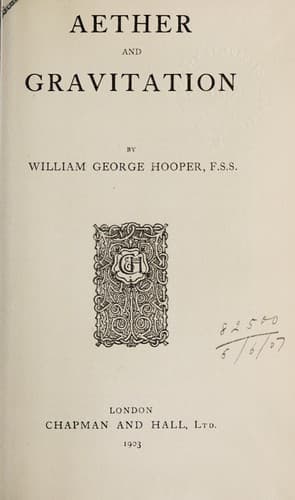
Ether (Space); Force and energy; Gravitation; Matter
That leads us to the next point regarding this principle of
transformation, which is that all transformations of energy take place
in fixed proportions. When a certain quantity of coal is burned, a
certain quantity of heat, or thermal energy as it is sometimes called,
is produced, and the quantity of heat so produced is definitely
proportionate to the quantity of coal consumed.
If a certain quantity of coal were burned in a perfect steam-engine,
that is one in which there would be no loss of heat, then also a
definite amount of mechanical work would be done, which would be
strictly proportionate to the heat generated by the consumption of the
coal. So that when coal is put into an engine, the potential energy of
the coal is transformed into kinetic energy of the steam, and that is
again transformed into actual mechanical energy of the engine itself, by
which work is done in driving or pushing or pulling the train along, and
the amount of work done is proportionate to the coal consumed.
Illustrations of transformation are common, and may be seen by any
person living in a large town. Thus at any electrical station or
electric tram terminus, these transformations of various forms of energy
are very familiar sights. We have first the transformation of the coal
in the furnace into heat. This heat converts water into steam, whose
motion is communicated by proper machinery into a dynamo, the product of
which is electricity. That electricity is then conveyed along wires, and
work is done by it, by moving trams along the connected tram system, or
it may be converted into heat in the carbon filament in the car itself,
which, if heated enough, will then produce the electric light. So that
starting from the coal, we have several transformations therefrom into
the forms of heat, light, motion, and finally mechanical energy, which
results in Work. The question arises as to what is the law of
equivalence in regard to the transformation of energy. That is, if we
have a certain amount of energy of a given sort, how much of any other
sort can be produced by it? The answer is partly to be found in a
statement made by Joule in 1843, which practically embodies what is
known as the first law of Thermo-dynamics, and is as follows: "When
equal quantities of mechanical effects are produced by any means
whatever, from purely thermal sources, or lost in purely thermal
effects, then equal quantities of heat are put out of existence or are
generated, and for every unit of heat measured by raising a pound of
water one degree F. in temperature, you have to expend 772 foot-pounds
of work." From this law we learn that heat may be used to do work, but
that a certain amount of heat is always used up in the process. It can
also be demonstrated that electric currents can do work, but to generate
the currents a certain amount of work must be done.
Public-domain text, read in full here on John Shaqi.
Reviews
Reviews
No reviews yet
Be the first to share your thoughts on this work.
Elsewhere in the archive
Join the Discussion
Join the discussion
Sign in to leave a comment or review.
Sign InorCreate an account