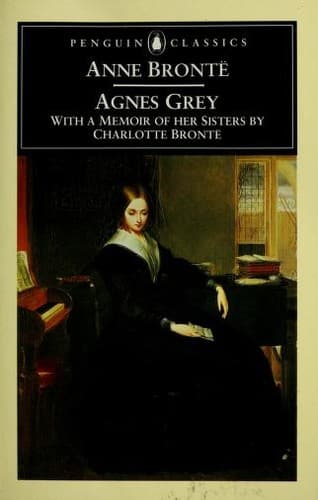
Autobiographical fiction; England -- Fiction; Feminist fiction; Governesses -- Fiction; Single women -- Fiction
Then, stretching herself upon a couch, she motioned me to a capacious
easy-chair that stood opposite—not before the fire, but before a wide
open window; for it was summer, be it remembered; a sweet, warm evening
in the latter half of June. I sat for a moment in silence, enjoying the
still, pure air, and the delightful prospect of the park that lay
before me, rich in verdure and foliage, and basking in yellow sunshine,
relieved by the long shadows of declining day. But I must take
advantage of this pause: I had inquiries to make, and, like the
substance of a lady’s postscript, the most important must come last. So
I began with asking after Mr. and Mrs. Murray, and Miss Matilda and the
young gentlemen.
I was told that papa had the gout, which made him very ferocious; and
that he would not give up his choice wines, and his substantial dinners
and suppers, and had quarrelled with his physician, because the latter
had dared to say that no medicine could cure him while he lived so
freely; that mamma and the rest were well. Matilda was still wild and
reckless, but she had got a fashionable governess, and was considerably
improved in her manners, and soon to be introduced to the world; and
John and Charles (now at home for the holidays) were, by all accounts,
“fine, bold, unruly, mischievous boys.”
“And how are the other people getting on?” said I—“the Greens, for
instance?”
“Ah! Mr. Green is heart-broken, you know,” replied she, with a languid
smile: “he hasn’t got over his disappointment yet, and never will, I
suppose. He’s doomed to be an old bachelor; and his sisters are doing
their best to get married.”
“And the Melthams?”
“Oh, they’re jogging on as usual, I suppose: but I know very little
about any of them—except Harry,” said she, blushing slightly, and
smiling again. “I saw a great deal of him while we were in London; for,
as soon as he heard we were there, he came up under pretence of
visiting his brother, and either followed me, like a shadow, wherever I
went, or met me, like a reflection, at every turn. You needn’t look so
shocked, Miss Grey; I was very discreet, I assure you, but, you know,
one can’t help being admired. Poor fellow! He was not my only
worshipper; though he was certainly the most conspicuous, and, I think,
the most devoted among them all. And that detestable—ahem—and Sir
Thomas chose to take offence at him—or my profuse expenditure, or
something—I don’t exactly know what—and hurried me down to the country
at a moment’s notice; where I’m to play the hermit, I suppose, for
life.”
And she bit her lip, and frowned vindictively upon the fair domain she
had once so coveted to call her own.
“And Mr. Hatfield,” said I, “what is become of him?”
Again she brightened up, and answered gaily—“Oh! he made up to an
elderly spinster, and married her, not long since; weighing her heavy
purse against her faded charms, and expecting to find that solace in
gold which was denied him in love—ha, ha!”
Public-domain text, read in full here on John Shaqi.
Reviews
Reviews
No reviews yet
Be the first to share your thoughts on this work.
Elsewhere in the archive
Join the Discussion
Join the discussion
Sign in to leave a comment or review.
Sign InorCreate an account