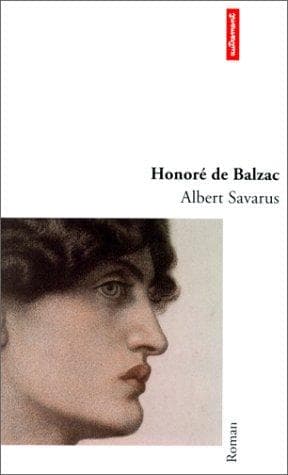
France -- Social life and customs -- 19th century -- Fiction; French fiction -- Translations into English
A month after this catastrophe the mother and daughter had settled
in the Hotel de Rupt, where they lived in savage silence. Rosalie was
suffering from real sorrow, which had no visible outlet; she accused
herself of her father’s death, and she feared another disaster, much
greater in her eyes, and very certainly her own work; neither Girardet
the attorney nor the Abbe de Grancey could obtain any information
concerning Albert. This silence was appalling. In a paroxysm of
repentance she felt that she must confess to the Vicar-General the
horrible machinations by which she had separated Francesca and Albert.
They had been simple, but formidable. Mademoiselle de Watteville had
intercepted Albert’s letters to the Duchess as well as that in which
Francesca announced her husband’s illness, warning her lover that she
could write to him no more during the time while she was devoted, as was
her duty, to the care of the dying man. Thus, while Albert was wholly
occupied with election matters, the Duchess had written him only two
letters; one in which she told him that the Duc d’Argaiolo was in
danger, and one announcing her widowhood--two noble and beautiful
letters which Rosalie kept back.
After several nights’ labor she succeeded in imitating Albert’s writing
very perfectly. She had substituted three letters of her own writing
for three of Albert’s, and the rough copies which she showed to the old
priest made him shudder--the genius of evil was revealed in them to such
perfection. Rosalie, writing in Albert’s name, had prepared the Duchess
for a change in the Frenchman’s feelings, falsely representing him as
faithless, and she had answered the news of the Duc d’Argaiolo’s death
by announcing the marriage ere long of Albert and Mademoiselle de
Watteville. The two letters, intended to cross on the road, had, in
fact, done so. The infernal cleverness with which the letters were
written so much astonished the Vicar-General that he read them a second
time. Francesca, stabbed to the heart by a girl who wanted to kill love
in her rival, had answered the last in these four words: “You are free.
Farewell.”
“Purely moral crimes, which give no hold to human justice, are the most
atrocious and detestable,” said the Abbe severely. “God often punishes
them on earth; herein lies the reason of the terrible catastrophes which
to us seem inexplicable. Of all secret crimes buried in the mystery of
private life, the most disgraceful is that of breaking the seal of a
letter, or of reading it surreptitiously. Every one, whoever it may be,
and urged by whatever reason, who is guilty of such an act has stained
his honor beyond retrieving.
Public-domain text, read in full here on John Shaqi.
Reviews
Reviews
No reviews yet
Be the first to share your thoughts on this work.
Elsewhere in the archive
Join the Discussion
Join the discussion
Sign in to leave a comment or review.
Sign InorCreate an account