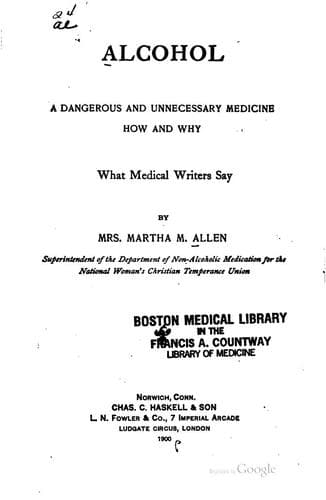
Alcohol: A Dangerous and Unnecessary Medicine, How and Why: What Medical Writers SayAllen, Martha Meir
Science
Alcohol: A Dangerous and Unnecessary Medicine, How and Why: What Medical Writers Say
Allen, Martha Meir
Alcohol -- Physiological effect; Temperance
"In cases of chronic dyspepsia the use of alcohol seems to be
particularly deleterious, although not infrequently prescribed,
if not in the form of alcohol or ordinary alcoholic liquors, in
the form of some so-called 'bitters,' 'elixir' or 'cordial.'
Nothing could be further removed from the truth than the popular
notion that alcohol, at least in the form of certain wines, is
helpful to digestion. Roberts showed, years ago, that alcohol
even in small doses, diminishes the activity of the stomach in
the digestion of proteids. Gluzinski showed, ten years ago, that
alcohol causes an arrest in the secretion of pepsin, and also of
its action upon food. Wolff showed that the habitual use of
alcohol produces disorder of the stomach to such a degree as to
render it incapable of responding to the normal excitation of
the food. Hugounencq found that all wines, without exception,
prevent the action of pepsin upon proteids. The most harmful are
those which contain large quantities of alcohol, cream of tartar
or coloring matter. Wines often contain coloring matters which
at once completely arrest digestion, such as methylin blue and
fuchsin.
"A few years ago I made a series of experiments in which I
administered alcohol in various forms with a test meal, noting
the effect upon the stomach fluid as determined by the accurate
chemic examination of the method of Hayem and Winter. The result
of these experiments I reported at the 1893 meeting of the
American Medical Temperance Association. The subject of
experiment was a healthy young man whose stomach was doing a
slight excess of work, the amount of combined chlorin being
nearly fifty per cent. above normal, although the amount of free
hydrochloric acid was normal in quantity. Four ounces of claret
with the ordinary test meal reduced the free hydrochloric acid
from 28 milligrams per 100 c. c. of stomach fluid to zero, and
the combined chlorin from .270 to .125. In the same case the
administration of two ounces of brandy with the ordinary test
meal reduced the combined chlorin to .035, scarcely more than
one eighth of the original amount, the free hydrochloric acid
remaining at zero. Thus it appears that four ounces of claret
produced marked hypopepsia in a case of moderate hyperpepsia,
whereas two ounces of brandy produced practically apepsia."
FAINTING OR SYNCOPE:--The following letter from the late Sir B. W.
Richardson was addressed to a lady who had sought the great physician's
advice on the subject:--
"25 Manchester Square, W., July 18, 1896.
Public-domain text, read in full here on John Shaqi.
Reviews
Reviews
No reviews yet
Be the first to share your thoughts on this work.
Elsewhere in the archive
Join the Discussion
Join the discussion
Sign in to leave a comment or review.
Sign InorCreate an account