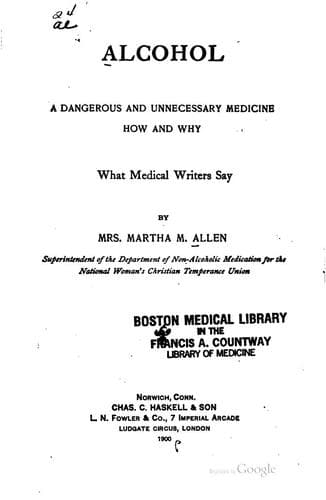
Alcohol: A Dangerous and Unnecessary Medicine, How and Why: What Medical Writers SayAllen, Martha Meir
Science
Alcohol: A Dangerous and Unnecessary Medicine, How and Why: What Medical Writers Say
Allen, Martha Meir
Alcohol -- Physiological effect; Temperance
"Any one who has ever witnessed the marvelous effects of
applications of this sort in reviving a flagging heart will
never doubt their efficacy, and will have no occasion to resort
to alcohol, or any other intoxicant, to stimulate a flagging
heart. The writer has employed these measures for stimulating
the heart for more than twenty years, and might cite hundreds of
instances in which their efficiency has been demonstrated. They
are applicable not only to the cardiac depression encountered in
the adynamic stage of typhoid and other fevers, but in cases of
heart failure from hemorrhage, of surgical shock, collapse under
chloroform or ether, opium poisoning, coal gas asphyxia,
drowning, etc."--Dr. J. H. Kellogg, in _Bulletin of the A. M. T.
A._, Jan., 1899.
Dr. N. S. Davis tells of a case of threatened collapse where he was
called in consultation. Patient was in a small, unventilated room.
"It was easy to see that what she needed was fresh air in her
lungs. Instead of giving alcohol in any form she was moved into
a large, well-ventilated room. All symptoms of 'heart failure'
disappeared. Had she begun to take whisky or brandy, physician
and friends would have attributed her recovery to that, when in
fact it would have retarded recovery by hindering oxygenation of
the blood."
"It would also be a very great mistake to suppose that when
reaction follows collapse, in cases in which alcohol has been
given, this result is always due to the alcohol. I have seen so
many cases of severe collapse recover without alcohol that I
cannot but be skeptical as to its necessity, and even as to its
value. I was much struck many years ago by a case of post partum
hemorrhage which was so severe that convulsions set in. I should
then have given brandy if there had been any to give, but there
was none in the house and none to be got. I administered
teaspoonfuls of hot water and the patient revived and recovered;
next day, except for anaemia, she was as well as ever, with no
reactionary fever or other disturbance, as would almost
certainly have been the case if brandy had been given.
"In collapse from hemorrhage, we have learned the value of
injections of warm saline water, either into the veins, the skin
or the rectum, and the same treatment is available in other
cases of collapse with contracted vessels.
Public-domain text, read in full here on John Shaqi.
Reviews
Reviews
No reviews yet
Be the first to share your thoughts on this work.
Elsewhere in the archive
Join the Discussion
Join the discussion
Sign in to leave a comment or review.
Sign InorCreate an account