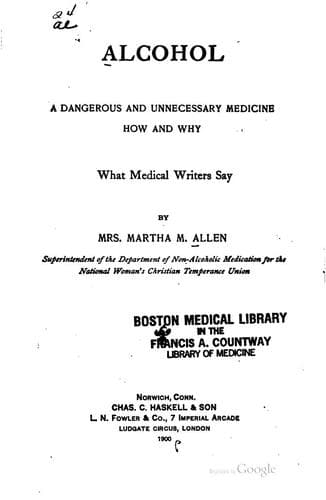
Alcohol: A Dangerous and Unnecessary Medicine, How and Why: What Medical Writers SayAllen, Martha Meir
Science
Alcohol: A Dangerous and Unnecessary Medicine, How and Why: What Medical Writers Say
Allen, Martha Meir
Alcohol -- Physiological effect; Temperance
"It is well known that some poisons are thrown off by the
kidneys, some by the lungs, while others again are attacked by
all the emunctories. The difference in the power of the system
to absorb different substances, appropriate whatever can be
utilized, and throw off whatever can not be used, is sometimes
called idiosyncrasy, but more properly it may be called vital
resistance, and upon the integrity of this power rests the
ability to combat disease in all its forms, whether it be the
absorption of any animal virus or the poison resulting from
undigested food. This ability is in proportion to the integrity
and soundness of every tissue and organ of the body. This may be
illustrated by the fact that with a person suffering from kidney
disease, which necessarily impedes elimination, the ordinary
effects of a poison are intensified; therefore whatever aids in
the promotion of good health, or in other words, the normal
action of all the functions, will contribute to the safety of
the individual in any and every emergency.
"When a person dies from the effect of poisoning, it is simply
because the system was unable to eliminate the offending
substance and was exhausted in the effort. There is a tolerance
of some substances which frequently results in chronic disease,
and again it is shown in what is called the cumulative effect or
acute disease.
"Those who would hold that a substance is at one time a
medicament, and at another time a poison, have much trouble in
drawing the line between the beneficial and the poisonous
effect. The idea that poisonous substances act on the system is
responsible for many grave mistakes, whereas always, and under
all circumstances, it is the system that does all the action.
"There might be some excuse for the idea that disease is an
entity, from the facts that have been brought to light by the
germ theory, but this theory is of recent date, while the entity
theory is as old as superstition.
"Snake poison, which may be cited as a type of other animal
poisons, takes effect through the circulation, and acts by
paralyzing the nerve centres, and by altering the condition of
the blood. In ordinary cases death seems to take place by arrest
of respiration, from paralysis of the nerves of motion. The
poison also acts septically, producing at a later period
sloughing and hemorrhage.
"Dr. Calmette, a noted French scientist, claims that what is
poisonous in the snake's bite, is not the venom absorbed into
the blood, but a principle which the blood itself has developed
out of the poison. This would necessitate very quick action when
the poison is inserted in one of the large veins, as that is
followed by instant death.
"The following cases fairly represent some of the tragedies that
are occurring in our everyday life.
Public-domain text, read in full here on John Shaqi.
Reviews
Reviews
No reviews yet
Be the first to share your thoughts on this work.
Elsewhere in the archive
Join the Discussion
Join the discussion
Sign in to leave a comment or review.
Sign InorCreate an account