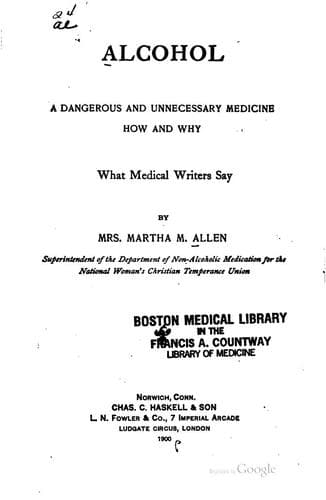
Alcohol: A Dangerous and Unnecessary Medicine, How and Why: What Medical Writers SayAllen, Martha Meir
Science
Alcohol: A Dangerous and Unnecessary Medicine, How and Why: What Medical Writers Say
Allen, Martha Meir
Alcohol -- Physiological effect; Temperance
"In the vast majority of cases there need be no anxiety so far
as the shock is concerned; reaction will occur in due time if
ordinary care be taken, and will be more natural and steady if
the system is not embarrassed by the presence of the narcotic
alcohol. In the state of collapse the voluntary nervous system
is depressed; alcohol diminishes the power and activity of the
nervous centres of the brain, hence its action is undesirable in
shock or collapse."--DR. J. J. RIDGE, London.
"No procedure could be more senseless than the administering
alcohol in shock. A stimulant of some kind is necessary in such
cases, and alcohol, instead of being a stimulant is a narcotic.
* * * * * Alcohol causes a decrease of temperature, the very
thing to be avoided in cases of shock."--DR. J. H. KELLOGG.
"I am perfectly sure that a large dose of alcohol in shock puts
a nail in the coffin of the patient."--DR. H. C. WOOD of the
University of Pennsylvania.
SINKING SENSATIONS:--Many women have a feeling of weakness or "goneness"
at about eleven o'clock in the morning, and are led by it to the
injurious practice of eating between meals. It is often due to
indigestion, or to the use of beer or wine. A few sips of hot milk, of
fruit juice, or even of cold water will often relieve it, especially if
total abstinence is persevered in.
SUDDEN ILLNESS:--"Those taken suddenly ill are likely to fare
best if placed in a recumbent position, with head slightly
elevated, all tightness of garments about the neck or waist
relieved, and a little cold water given in case of ability to
swallow. A mustard plaster on the back of the neck, or over the
stomach, and hot water or hot bottles to the feet, are never out
of place, while vinegar, or smelling salts, or dilute ammonia to
the nostrils is reviving."--EZRA M. HUNT, M. D., late secretary
of New Jersey State Board of Health.
"Both the popular and professional beliefs in the efficacy of
alcoholic liquids for relieving exhaustion, faintness, shock,
etc. are equally fallacious. All these conditions are temporary,
and rapidly recovered from by simply the recumbent position, and
free access to fresh air. Ninety-nine out of every hundred of
such cases pass the crisis before the attendants have time to
apply any remedies, and when they do, the sprinkling of cold
water on the face, and the vapor of camphor or carbonate of
ammonia to the nostrils, are the most efficacious remedies, and
leave none of the secondary evil effects of brandy, whisky or
wine."--DR. N. S. DAVIS.
Public-domain text, read in full here on John Shaqi.
Reviews
Reviews
No reviews yet
Be the first to share your thoughts on this work.
Elsewhere in the archive
Join the Discussion
Join the discussion
Sign in to leave a comment or review.
Sign InorCreate an account