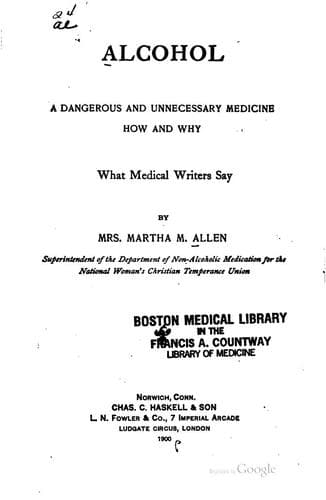
Alcohol: A Dangerous and Unnecessary Medicine, How and Why: What Medical Writers SayAllen, Martha Meir
Science
Alcohol: A Dangerous and Unnecessary Medicine, How and Why: What Medical Writers Say
Allen, Martha Meir
Alcohol -- Physiological effect; Temperance
"Can such an assumption be sustained by either established
facts, or correct reasoning? Can nervous and cardiac exhaustion,
induced by the presence of toxic agents in the blood, with
deficiency of both hemoglobin and oxygen, be relieved by a
simple _stimulant_, that neither neutralizes nor eliminates the
toxic agents, nor increases either the hemoglobin or oxygen?
That alcohol does not neutralize or destroy toxic ptomaines, or
tox-albumins, is proved by abundant clinical experience, and
also by the fact that chemists use it freely in the processes
for separating these substances from other organic matters for
experimental purposes. That its presence in the living body
retards metabolic changes generally, and thereby aids in
retaining instead of eliminating toxic agents of all kinds, has
been so fully shown in the pages of preceding numbers of the
_Medical Temperance Quarterly_, that the leading facts need not
be repeated here. That its presence does not increase the
hemoglobin, or favor oxy-hemoglobin or increased internal
distribution of oxygen, but decidedly the reverse, has been
equally well demonstrated by numerous and reliable experimental
researches in this and other countries.
"Then it must be conceded that alcohol is not capable of
fulfilling either of the important indications presented in the
treatment of typhoid fever as stated above. Nevertheless, the
advocates of its use apparently recognize but two ideas or
factors in these cases, namely, the popularly inherited
assumption that alcohol is a _stimulant_, and as the patient is
in danger from nervous and cardiac weakness, therefore the
alcohol must be given, _pro re nata_ without the slightest
regard to the existing causes of the weakness, or the _modus
operandi_ of the so-called stimulant.
"This is proved by the fact that they group together as
stimulants, and give to the same patient in alternate doses,
remedies of directly antagonistic action, as alcohol and
strychnine, or digitalis, etc.
"The accepted definition of a stimulant in medical literature,
is some agent capable of exciting or increasing _vital activity_
as a whole, or the natural activity of some one structure or
organ.
Public-domain text, read in full here on John Shaqi.
Reviews
Reviews
No reviews yet
Be the first to share your thoughts on this work.
Elsewhere in the archive
Join the Discussion
Join the discussion
Sign in to leave a comment or review.
Sign InorCreate an account