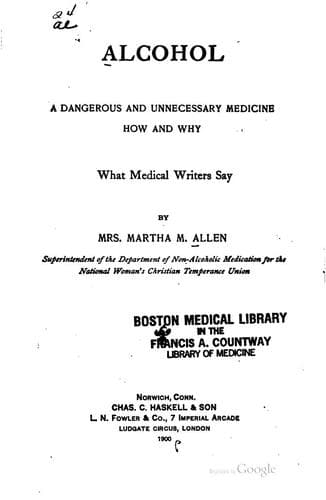
Alcohol: A Dangerous and Unnecessary Medicine, How and Why: What Medical Writers SayAllen, Martha Meir
Science
Alcohol: A Dangerous and Unnecessary Medicine, How and Why: What Medical Writers Say
Allen, Martha Meir
Alcohol -- Physiological effect; Temperance
"2. To sustain the vital and resisting powers of the patient.
"If the patient is seen early in the disease, it has been my
practice to immediately put him to bed and give a free dose of
magnesium sulphate. This is preferably given in the morning or
forenoon, and may be repeated once or twice on successive days.
Besides this the patient should have a large enema of water at a
temperature of from 75 deg. to 80 deg. F.; and this may be repeated
daily or even oftener, for some time, if necessary, to keep the
bowels empty of the poisonous substances.
"The salines and enemas thus used carry out bodily a large
number of germs and ptomaines that are present in the
intestines; and further, the salines, by producing an increased
secretion of the mucous membrane of the intestines, tend to
disentangle and set free many of the germs that have found a
lodging place in the walls of the intestines.
"For the elimination of the ptomaines which have been absorbed
into the circulation and carried to the tissues, nothing is
better than the internal use of water. From three to five pints
should be drunk during every twenty-four hours. It should be
taken in small quantities--six to eight ounces every hour or two
during waking hours, except when food is taken. I will refer to
this point more in detail later.
"A consideration of the general care of the patient properly
comes under the second head of the indications for treatment as
given above. The patient should be put to bed in a large, light,
well-ventilated room. At least two sides of the room should
communicate directly by windows with out-of-doors, in order that
the room may be properly ventilated.
"All unnecessary articles of furniture, such as carpets,
couches, upholstered chairs, pictures, etc. should be removed.
"The room should be thoroughly cleaned before the patient is put
into it.
"There should be two beds in the room for the use of the
patient. These should be, preferably, narrow and so placed in
the room that there is a free approach to both sides of the bed,
for the convenience of the nurse in giving treatment. Iron
bedsteads are preferable to wooden. The bedding should be firm,
yet soft and smoothly drawn. There should be just sufficient
covering to protect the body. The patient should be changed from
one bed to the other daily. This may be done by placing the two
beds side by side and carefully moving the patient from one to
the other. The sheets on the bed from which the patient has been
taken should be washed and disinfected at each change of the
beds, and all other bedding should be thoroughly aired and
exposed to the sunlight daily.
Public-domain text, read in full here on John Shaqi.
Reviews
Reviews
No reviews yet
Be the first to share your thoughts on this work.
Elsewhere in the archive
Join the Discussion
Join the discussion
Sign in to leave a comment or review.
Sign InorCreate an account