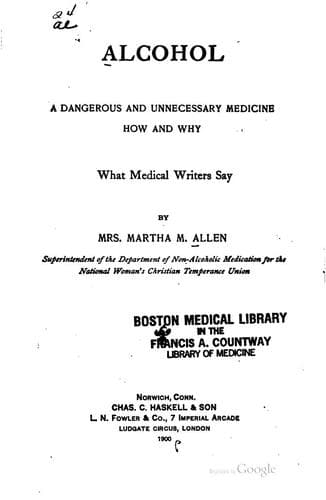
Alcohol: A Dangerous and Unnecessary Medicine, How and Why: What Medical Writers SayAllen, Martha Meir
Science
Alcohol: A Dangerous and Unnecessary Medicine, How and Why: What Medical Writers Say
Allen, Martha Meir
Alcohol -- Physiological effect; Temperance
"The flow of milk in her breasts has also diminished to such a
degree that she does not have half enough for her baby. Yet she
says the _beer_ makes her feel better after each drink, and that
the _gin_ helps to relieve the severe attacks of pain, and
consequently she thinks she could not do without them. It is
undoubtedly true that the patient feels temporary relief from
the anaesthetic effect of the alcohol in her beer and gin, just
as she would from any anaesthetic or narcotic. And it is equally
true that so long as the alcohol is present in her blood it so
modifies the hemoglobin and albuminous constituents, as to
diminish the reception and internal distribution of oxygen, and
thereby retards metabolic changes. But the combined influence of
the alcohol in retarding the internal distribution of oxygen and
the drain upon the nutritive elements of her blood, in
furnishing milk for her baby, led to rapid impoverishment of the
blood and tissues, and the early establishment of a sufficient
grade of gastritis to cause indigestion, frequent vomiting, and,
later, paroxysms of severe gastralgia, with general emaciation,
and loss of strength.
"In accordance with the present popular ideas, both in and out
of the profession, this patient tells me she has tried a great
variety of foods, peptonized, sterilized, and predigested, but
all to no purpose. And why?--Simply because her troubles are not
in the kind of food she takes, but in the morbid condition of
her blood, and of the mucous membrane and nerves of her stomach.
Consequently the rational indications for treatment are: (_a_)
to get her stomach and blood free from the alcohol of beer and
gin; (_b_) to encourage the reception and internal distribution
of oxygen by plenty of fresh air; (_c_) to give her the most
bland, or unirritating food in small, and frequently repeated
doses, of which good milk with lime-water, and milk and
wheat-flour gruel are the best; (_d_) such medicines as possess
sufficient antiseptic, and anodyne properties to allay the
irritability of the gastric mucous membrane, and lessen
fermentation."
CHAPTER X.
COMPARATIVE DEATH-RATES WITH AND WITHOUT THE USE OF ALCOHOL AS A REMEDY.
A study of statistics relating to the difference in results of the
treatment of disease with and without the use of alcohol, cannot but be
of great interest to all students of the alcohol question. The appended
statistics are culled mainly from the _Medical Pioneer_ of England, now,
_Medical Temperance Review_, the journal of the British Medical
Temperance Association, and from the _Bulletin of the American Medical
Temperance Association_.
A paragraph in the _British Medical Journal_, for Dec. 2, 1893, says:--
Public-domain text, read in full here on John Shaqi.
Reviews
Reviews
No reviews yet
Be the first to share your thoughts on this work.
Elsewhere in the archive
Join the Discussion
Join the discussion
Sign in to leave a comment or review.
Sign InorCreate an account