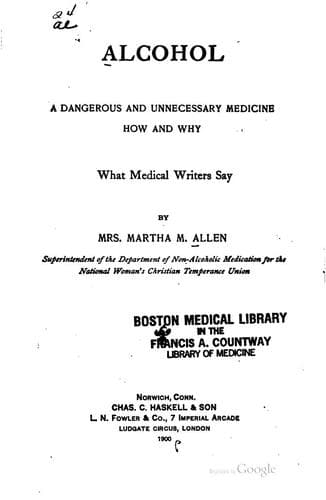
Alcohol: A Dangerous and Unnecessary Medicine, How and Why: What Medical Writers SayAllen, Martha Meir
Science
Alcohol: A Dangerous and Unnecessary Medicine, How and Why: What Medical Writers Say
Allen, Martha Meir
Alcohol -- Physiological effect; Temperance
"In 230 typhoid cases in St. Mary's Hospital, Dr. Chambers
reduced the ratio of deaths from 1 in 5 with alcohol to 1 in 40
without it. Dr. Perry, of Glasgow, found that of 534 cases
treated with alcohol, 138 died, while of 491 treated without
alcohol, only 9 died."
In a recent text-book on medicine occurs the following:--
"English physicians use spirits in fevers, and all experience
sustains the conviction that no substitute has been found for
them."
In a late number of the _Temperance Record_, Dr. Smith gives a different
view of the experience of English physicians:--
"When Bentley Todd was at King's College, and leading his
profession, brandy was the rule in febrile cases. Then the
mortality varied from twenty-five to thirty-five per cent. That
the treatment was as fatal as the disease, experience
demonstrates:--
"1. Professor W. T. Gairdner, of Glasgow, writing to the Lancet
(1864), gave his experience as follows:--
Fever cases Average of
treated. wine and spirits. Mortality.
1,829 34 oz. to each 17.69 per cent.
595 2-1/2 oz. to each 11.93 per cent.
212 none 1 death only.
(young lives)
"These were mostly typhus cases, but the rationale, so far as
alcohol is concerned, is the same as in typhoid.
"2. At the British Medical Association in 1879, Professor H.
MacNaughton Jones gave particulars of 340 cases of typhus,
typhoid and simple fever. I append a summary:--
Cases. Deaths. Mortality
per cent.
Given brandy 58 19 32.7
Given claret 51 2 3.8
Given no alcohol 231 4 1.7
"3. Dr. J. C. Pearson writes to the _Lancet_ (Dec. 5 and 26,
1891), giving his experience of typhoid. He had treated several
hundreds of cases without a single death, and never prescribed
stimulants in any shape or form in the disease.
"4. Dr. Knox Bond writes to the _Lancet_ (Nov. 25, 1893), giving
his experience of typhoid at the Liverpool Fever Hospital. He
says: 'As a resident for some years in the fever hospitals, my
views of the value of alcohol in fever underwent, solely as a
result of the experience there gained, entire modification. The
conviction became forced upon my mind that in no case in which
it was used did benefit to the patient ensue; that in a
proportion of cases its use was distinctly hurtful; and that in
a small but appreciable number of cases the resultant harm was
sufficient to tilt the balance as against the recovery of the
patient.'
"In plain terms, alcohol tended to the destruction of the
patients. Dr. Bond's figures are:--
No. of cases. No. of deaths.
Public-domain text, read in full here on John Shaqi.
Reviews
Reviews
No reviews yet
Be the first to share your thoughts on this work.
Elsewhere in the archive
Join the Discussion
Join the discussion
Sign in to leave a comment or review.
Sign InorCreate an account