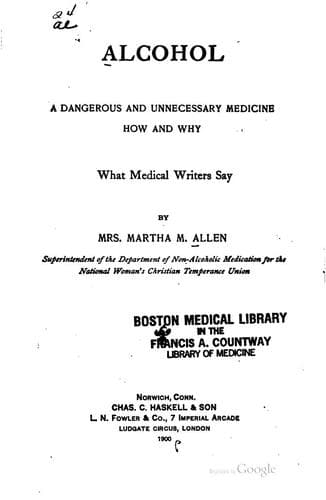
Alcohol: A Dangerous and Unnecessary Medicine, How and Why: What Medical Writers SayAllen, Martha Meir
Science
Alcohol: A Dangerous and Unnecessary Medicine, How and Why: What Medical Writers Say
Allen, Martha Meir
Alcohol -- Physiological effect; Temperance
"The surgical cases include more than 300 cases of ovariotomy,
and over 300 other cases involving the peritoneal cavity, such
as operations for strangulated hernia, the radical cure of
hernia, etc. The statistics of death and recoveries are
certainly as good as can be produced by any hospital in the
world, dealing with the same class of cases. The total mortality
from the operation of ovariotomy, including nearly 300 cases, is
less than three per cent., and for the last few years, in which
the antiseptic measures have been perfected, the record is still
better, showing a succession of 172 cases of laparotomy for the
removal of ovarian tumors, or diseased uterus and ovaries,
without a death. These cases include a number of hysterectomies,
and many cases so desperate that those who trust in alcohol as a
heart stimulant, and as a means of supporting the vital
energies, would certainly have considered it necessary to resort
to the use of this drug. Nevertheless, it was not administered
in a single case, and I have seen no reason to regret its
non-use in a single instance."
Dr. T. D. Crothers, of Hartford, Conn., tells the following:--
"In a large hospital a study of the mortality of pneumonia
indicated a greater fatality at intervals of six months. There
were five per cent. more deaths during periods of two months at
a time, twice during the year. This extended back for two years,
and was finally narrowed down to the service of an eminent
physician who gave spirits freely in all cases of pneumonia from
their entrance to the hospital. The other visiting physicians
gave very little spirits, and only in the later stages. The
physician was skeptical of these statistics, but finally
consented to test them by giving up spirits practically in all
cases of pneumonia. This was continued for a year, and the
mortality went back to the average statistics. That physician
has abandoned alcohol as a food and a medicine, only in very
limited degree. He writes, 'My stupidity in accepting theories
and statements of others, concerning spirits, which I could have
tested personally, is a source of deep sorrow, and I do not know
but it could be called criminal. I certainly feel that
punishment would be just.'"
Brandy has been considered the great necessity in cholera, yet the use
of it and other alcoholics are known to expose people to greater danger
when this disease prevails.
The _Bulletin of the A. M. T. A._ is authority for the following:--
"During the epidemic of 1832, Dr. Bronson said: 'In Montreal
1,000 persons have died of cholera, only two of whom were
teetotalers.' A Montreal paper said: 'Not a drunkard who has
been attacked has recovered from the disease, and almost all the
victims have been at least moderate drinkers.'
Public-domain text, read in full here on John Shaqi.
Reviews
Reviews
No reviews yet
Be the first to share your thoughts on this work.
Elsewhere in the archive
Join the Discussion
Join the discussion
Sign in to leave a comment or review.
Sign InorCreate an account