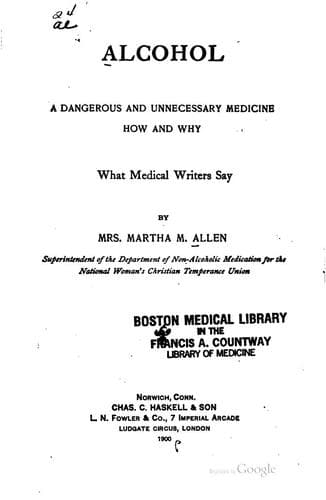
Alcohol: A Dangerous and Unnecessary Medicine, How and Why: What Medical Writers SayAllen, Martha Meir
Science
Alcohol: A Dangerous and Unnecessary Medicine, How and Why: What Medical Writers Say
Allen, Martha Meir
Alcohol -- Physiological effect; Temperance
"The truth is that all intelligent physicians and writers on
therapeutics of the present day agree in stating that alcohol in
large doses directly diminishes all the vital processes in the
living body, and in still larger doses suspends the life of the
individual by paralyzing the cerebral, vasomotor, respiratory
and cardiac functions, generally in the order named. If large
doses produce such effects, we must logically claim that small
doses act in the same direction, but in less degree. In other
words, alcohol is as truly and exclusively an anaesthetic as is
ether or chloroform, and, like them, is to be used as a medicine
only temporarily to relieve pain, or suspend nerve sensibility.
But as for these purposes it is less efficient than either ether
or chloroform, and other narcotics, there is no necessity for
using it as a remedy in the treatment of disease. And in health
its use in any dose can be productive of nothing but injury. The
only legitimate fields for the uses of alcohol are in chemistry,
pharmacy and the arts."
In another issue of the same magazine, Dr. Davis writes of the
investigations pursued by M. Robin of France in regard to the chemistry
of respiration. These investigations, he says, afford conclusive proof
that the acts of oxidation are defensive processes of the organism in
its struggle with bacteria, and therefore that the physician should
favor in every possible way the absorption of oxygen in every infection,
especially when there are typhoid complications.
He then speaks of the researches of other scientists in the same line,
concluding thus:--
"If we add to the foregoing investigations the results obtained
by Dr. A. C. Abbott, demonstrating that the presence of alcohol
directly diminished the vital resistance to infections, we
cannot fail to see that the administration of alcohol in
diphtheria, typhoid fever, pneumonia and other infectious
diseases, is directly contraindicated. If, as shown by M. Robin,
'the acts of oxidation are defensive processes' against
bacterial infections, then certainly the administration of
alcohol to patients with such infections is in the highest
degree illogical and injurious. The oxygen being obtained for
oxidation purposes in the blood and tissues, through the
respiratory process, it would be equally absurd to administer
alcohol in all cases in which it is desirable to increase the
processes of oxidation, as a long series of experiments has
shown that the presence of alcohol diminishes the efficiency of
the respiratory process in direct proportion to the quantity
used.
Public-domain text, read in full here on John Shaqi.
Reviews
Reviews
No reviews yet
Be the first to share your thoughts on this work.
Elsewhere in the archive
Join the Discussion
Join the discussion
Sign in to leave a comment or review.
Sign InorCreate an account