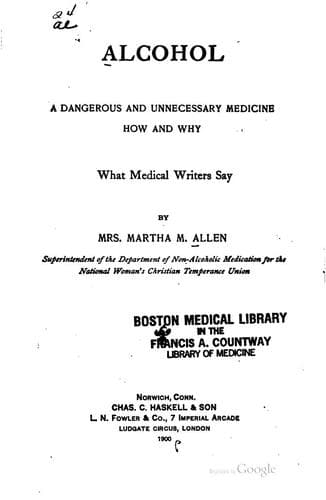
Alcohol: A Dangerous and Unnecessary Medicine, How and Why: What Medical Writers SayAllen, Martha Meir
Science
Alcohol: A Dangerous and Unnecessary Medicine, How and Why: What Medical Writers Say
Allen, Martha Meir
Alcohol -- Physiological effect; Temperance
"On the other side, there are practitioners who, under the
magnetism of public opinion, as earnestly believe the opposite
in relation to alcohol, who declare they could not,
conscientiously, practice their profession if they were
debarred the use of alcohol, and who look on the advance and the
growth of scientific abstaining principles--which they cannot
avoid recognizing--with positive dread. The extremists on this
side are indeed extreme in their fanaticism. They shut their
eyes to the most obvious facts, and do not hesitate in their
blindness to misrepresent the most obvious truths. They affirm
that under the influence of total abstinence and, by inference,
because of total abstinence, the yearly decreasing death-rate of
the population is accompanied by reduction of vitality; that
people who live long are more enfeebled than those who live
short lives and merry; that under abstinence from alcohol
fearful diseases are being developed; that the total abstainers
have less power for resisting disease than the moderate
temperate; and that under the current system of advance towards
total abstinence, a very small advance yet by the way, diseases
of a low type have developed and extended their ravages."
It is only physicians of large conscientiousness, or of great
independence of character, who will dare to go counter to the prejudices
of the people.
Consequently, it is necessary to educate _the people_ in the teachings
of those physicians, whose eminence in the profession has permitted
them, or whose conscientiousness has driven them, to expose the
delusions concerning the medical value of alcoholic beverages. When the
people cease to believe in alcoholic remedies, physicians will no longer
prescribe them. But while the majority desire the "physicians'
prescription" as a cover for indulgence, there will be found physicians
willing to give such prescriptions.
That the prescription of alcohol by physicians is largely a matter of
routine may be seen from the following two cases, reported to the writer
by county superintendents of the department of Medical Temperance.
In the first case, the physician said to the nurse, "If the patient's
heart becomes weak, you might give a little brandy or whisky." Seeing
reluctance expressed upon the nurse's countenance, he added hastily, "Or
coffee, strong coffee will do just as well." The nurse in reporting this
to the writer, said, "Why couldn't he have ordered coffee in the first
place if he thought it equally good?"
The second case was that of an aged woman whose physician ordered whisky
as a tonic. Her granddaughter ventured to ask, "Would not whisky have a
narcotic rather than a tonic effect?" He replied thoughtfully, "Well,
tell the truth, I suppose it would."
CHAPTER XIII.
ALCOHOLIC PROPRIETARY OR 'PATENT' MEDICINES.
Public-domain text, read in full here on John Shaqi.
Reviews
Reviews
No reviews yet
Be the first to share your thoughts on this work.
Elsewhere in the archive
Join the Discussion
Join the discussion
Sign in to leave a comment or review.
Sign InorCreate an account