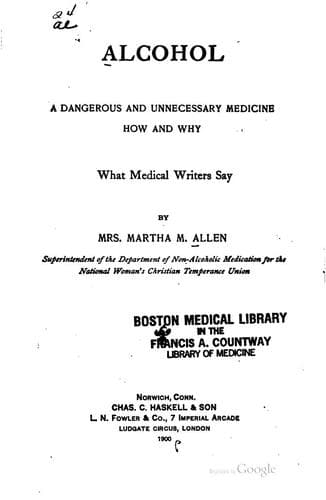
Alcohol: A Dangerous and Unnecessary Medicine, How and Why: What Medical Writers SayAllen, Martha Meir
Science
Alcohol: A Dangerous and Unnecessary Medicine, How and Why: What Medical Writers Say
Allen, Martha Meir
Alcohol -- Physiological effect; Temperance
"Cough mixtures as a rule, do more harm than good. Nine times
out of ten the principal ingredient is opium. It is true that
opium may lessen the tendency to cough, but it does great damage
by arresting the normal secretions, and the system becomes
affected by the poisons from the kidneys, skin, stomach,
intestines and the mucous membrane lining the upper air
passages. Not only do these mixtures arrest every secretion in
the body, but they also show their deteriorating and degrading
effect through the stomach. They contain substances which tend
to disorder and derange digestion."
Several years ago the Post-Office Department at Washington was led to
take an interest in the question of fraudulent "patent" medicines, and
an examination of many of these nostrums was undertaken by government
chemists. Fraud orders were issued against some of the most flagrant
offenders, forbidding them the use of the mails. This has not done away
with the evil, however, for they usually move to another city, and begin
business again under another name.
The examinations made for the Post Office Department revealed the fact
that a great many of the so-called medicines on the market were
intoxicating beverages in disguise. The Internal Revenue Department then
took up the matter and a long list of these beverage medicines was sent
out to internal revenue agents with instructions that these must not be
sold henceforth unless by persons paying a special tax for the sale of
alcoholic beverages.
Some of the manufacturers of these nostrums availed themselves of
opportunity given to add a recognized medicinal agent to their flavored
alcohol and water and such preparations were stricken from the list of
those requiring a whisky license for their sale. Peruna and Hostetter's
Bitters were the best-known of these. Peruna had been up to this time
what government chemists called "a cheap cocktail." The report of the
pure food commissioner of North Dakota for 1906 gives on page 157 an
analysis of it as now upon the market: "Alcohol by volume, 21.25 per
cent.; total solids, 3.846 per cent.; ash, .158 per cent." The report
says:--
"The only thing of a medicinal nature that we could find in this
preparation appeared to be a small amount of senna combined with
a bitters of some kind."
Proprietary "Foods" have not escaped attention from chemists. Dr.
Charles Harrington, for several years secretary of Massachusetts Board
of Health, was the first to publish an analysis of these preparations
showing their alcoholic strength and their small nutritive content. He
lists "foods" examined by him as follows:--
Public-domain text, read in full here on John Shaqi.
Reviews
Reviews
No reviews yet
Be the first to share your thoughts on this work.
Elsewhere in the archive
Join the Discussion
Join the discussion
Sign in to leave a comment or review.
Sign InorCreate an account