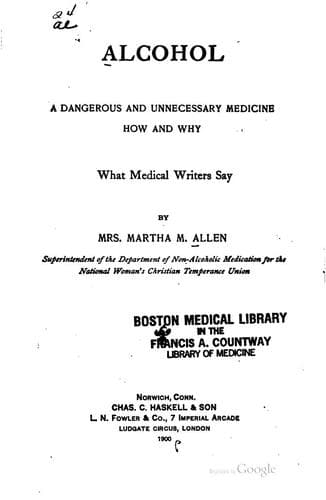
Alcohol: A Dangerous and Unnecessary Medicine, How and Why: What Medical Writers SayAllen, Martha Meir
Science
Alcohol: A Dangerous and Unnecessary Medicine, How and Why: What Medical Writers Say
Allen, Martha Meir
Alcohol -- Physiological effect; Temperance
It may well be asked, Would any one of these well-to-do newspaper owners
entrust himself, or any of his family, in time of sickness to the
cure-all imposters whose nostrums they advertise? If one of their
children had anaemia would they rely on Pink Pills for a cure? If they
had a genuine catarrh would they expect it to be cured by Peruna? Never!
They would seek the very best medical advice obtainable. Yet, for the
ignorant, credulous, sick and suffering poor they allow traps to be laid
to rob of both money and such chances of recovery as might come from
proper medical attendance.
CHAPTER XIV.
"DRUGGING."
The main reason why so many people use patent medicines is the popular
supposition that drugs cure disease. This is a great error. _Drugs never
cure disease._ Nature alone has power to heal. There are agents, which
in the hands of a trained and painstaking physician may assist nature,
but the physician needs to understand something of the idiosyncrasies of
his patient's system, or the use of these agents may do great harm
instead of good. Those medical men who have made the most diligent study
of health and disease assert as their deliberate opinion that excessive
professional drugging has been decidedly destructive of human life.
Dr. Jacob Bigelow, professor in the medical department of Harvard
University, in a work published a few years ago stated as his belief
that the unbiased opinion of most medical men of sound judgment, and
long experience, is that the amount of death and disaster in the world
would be less, if all diseases were left to themselves, than it now is
under the multiform, reckless, and contradictory modes of practice, with
which practitioners of diverse denominations carry on their
differences, at the expense of the patient.
Sir John Forbes, M. D., F. R. S., said:--
"Some patients get well with the aid of medicine, more without
it, and still more in spite of it."
Dr. Bostwick, author of _The History of Medicine_, said:--
"Every dose of medicine given is a blind experiment upon the
vitality of the patient."
Dr. James Johnson, editor of the _Medico-Chirurgical Review_, says:--
"I declare as my conscientious conviction founded on long
experience and reflection, that if there were not a single
physician, surgeon, man-midwife, chemist, apothecary, druggist
nor drug on the face of the earth, there would be less sickness
and less mortality than now prevail."
Prof. J. W. Carson, of the New York College of Physicians and Surgeons,
says:--
"We do not know whether our patients recover because we give
them medicine, or because nature cures them. Perhaps bread-pills
would cure as many as medicine."
Prof. Alonzo Clark, of the same college, has said:--
"In their zeal to do good physicians have done much harm; they
have hurried many to the grave who would have recovered if left
to nature."
Prof. Martin Paine, of the New York University Medical College, said:--
Public-domain text, read in full here on John Shaqi.
Reviews
Reviews
No reviews yet
Be the first to share your thoughts on this work.
Elsewhere in the archive
Join the Discussion
Join the discussion
Sign in to leave a comment or review.
Sign InorCreate an account