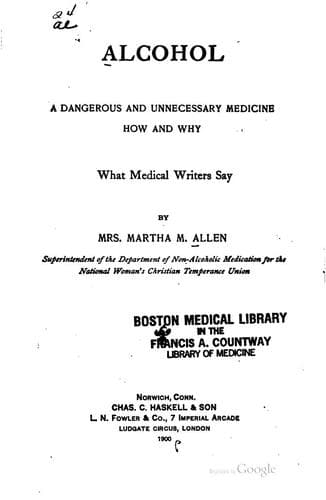
Alcohol: A Dangerous and Unnecessary Medicine, How and Why: What Medical Writers SayAllen, Martha Meir
Science
Alcohol: A Dangerous and Unnecessary Medicine, How and Why: What Medical Writers Say
Allen, Martha Meir
Alcohol -- Physiological effect; Temperance
"What the real action of the drug is, and how to counteract its
influence, are at present puzzling questions to the medical
fraternity. A leading member of the profession to whom these
questions were put replied after careful consideration as
follows: 'Its physiological action is practically unknown. As an
analgesic, it is uniform in its action, and this is due to the
suspension of the physiological functions of the sensory cells
which it comes in contact with. Beyond this, it is an excitant
of the cerebro-spinal axis, later it has a peculiar action on
the encephalon, manifest in a wide range of psychical phenomena.
Beyond this a great variety of widely variable symptoms appear.
In some cases all the intellectual faculties are excited to the
highest degree. In others a profound lowering of the senses and
functional activities occur. Morphine-takers can use large
quantities of cocaine without any bad symptoms. Alcoholics are
also able to bear large doses. Not unfrequently the excitement
caused by cocaine goes on to convulsions, and death. Sometimes
its action is localized to one part of the cerebro-spinal axis,
and then to another. In some cases well-marked cerebral anaemia
appears, and for a time is alarming, but soon passes away.
"Small doses frequently given are more readily absorbed than
large doses. Habitues always use weak solutions, the effects
being more pleasing with less excitation. Morphine and alcoholic
inebriates very soon acquire certain tolerance to large doses
taken at once. The cocaine user takes large quantities, but in
small doses frequently repeated. He becomes frightened at the
effects of large doses, and when he cannot get the effects from
small (to him safe) doses, he resorts to alcohol, morphine, or
chloral. In many cases memories of the delusions and
hallucinations are so vivid and distressing that other narcotics
are used to prevent their recurrence. In other cases the
recollection is very confused and vague, and strong suspicions
fill the mind that the real condition is grossly exaggerated by
the friends for some deterring effect. In common with opium and
alcoholics, there is moral paralysis, untruthfulness, and low
cunning in order to conceal and explain the condition by other
than the real causes."
Hoffman Drops are used considerably as a heart stimulant. They are much
more intoxicating than whisky, and, used as a beverage, make the drinker
crazy while under their influence. According to Dr. F. E. Jones, of
Mass. Board of Health, they consist of 325 parts ether, 650 parts
alcohol, and 25 parts ether oil. They are said to have a very bad effect
upon the kidneys.
_The Banner of Gold_ for Oct., 1898, contained a lengthy article upon
the dangers of drugging, from which an extract is given here:--
Public-domain text, read in full here on John Shaqi.
Reviews
Reviews
No reviews yet
Be the first to share your thoughts on this work.
Elsewhere in the archive
Join the Discussion
Join the discussion
Sign in to leave a comment or review.
Sign InorCreate an account