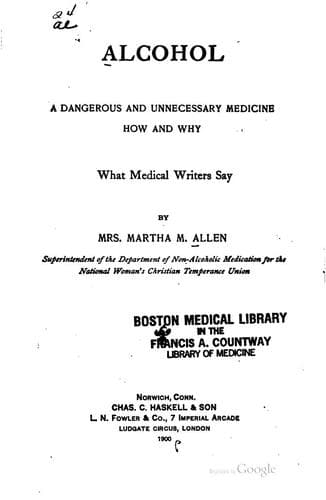
Alcohol: A Dangerous and Unnecessary Medicine, How and Why: What Medical Writers SayAllen, Martha Meir
Science
Alcohol: A Dangerous and Unnecessary Medicine, How and Why: What Medical Writers Say
Allen, Martha Meir
Alcohol -- Physiological effect; Temperance
"For the information of those of our readers, who are not
familiar with the nature and use of toxic drugs, we here refer
briefly to the prominent characteristics of a few most
dangerously potent for evil, and seductive in kind.
OPIUM AND MORPHINE:--"Gum opium, the dried milky exudate from
the green capsules of the white poppy, and its
product--morphine--are the most reliable drugs known for the
relief of pain. The dose of gum opium in medicine is from 1/4 to
1 grain. It contains from 8 to 14 per cent. of morphine, which
is its principal alkaloid. Opium is a much more stable, and
stronger, sedative than morphine. The cumulative effect of
repeated medicinal doses is frequently observed, and is followed
by dangerous symptoms. It is both a sedative and hypnotic, and,
if given in large doses, quiets the brain, and excites the
spinal cord. Small doses have little perceptible effect upon the
circulation, but, under the influence of large doses, the pulse
is retarded, and the respiration becomes fuller, deeper, and
slower. In poisonous doses the pulse may become rapid, and great
depression follow, the respiratory centres are paralyzed, thus
causing death. If taken in from 2 to 4 grain doses it produces
deep comatose sleep, full breathing, full pulse, dry skin, and
contracted pupils. If the dose is sufficiently large, the sleep
will be more profound, the patient can hardly be roused, and if
awakened quickly, he sinks back into slumber. The face may be
swollen, and reddened, and the lips deeply tinged with blue. At
this stage the breathing may be characterized as puffing.
Respiration may be from 8 to 10 per minute, perhaps be reduced
to 4, 2 or 1, and as the toxic effect is more marked, it becomes
shallow, the pupils are contracted, and the patient is so
thoroughly narcotized that nothing will arouse him, the heart
ceases to beat, and he dies by respiratory failure, or paralysis
of the pneumogastric nerve.
"Morphine, extracted from gum opium by a slow and expensive
process, is used much less in proprietary medicines than is
tincture of opium, which is more easily manufactured.
"A medicinal dose of sulphate of morphine is from 1/8 to 1/4 of
a grain. One grain is a dangerous dose, and 2 grains are liable
to prove fatal. Morphine is a true narcotic. It is a sedative,
lessens tissue change, and weakens every function of the body.
Public-domain text, read in full here on John Shaqi.
Reviews
Reviews
No reviews yet
Be the first to share your thoughts on this work.
Elsewhere in the archive
Join the Discussion
Join the discussion
Sign in to leave a comment or review.
Sign InorCreate an account