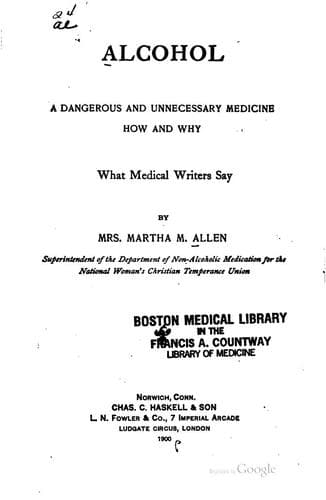
Alcohol: A Dangerous and Unnecessary Medicine, How and Why: What Medical Writers SayAllen, Martha Meir
Science
Alcohol: A Dangerous and Unnecessary Medicine, How and Why: What Medical Writers Say
Allen, Martha Meir
Alcohol -- Physiological effect; Temperance
"Only precise evidence that it (alcohol) is able to protect
albumen from destruction can warrant its employment and
establish its value as a food in the sick diet. And this
evidence which is of determinative importance must be looked
upon as having failed, according to the recent investigations of
Stammreich and Miura (who both worked under von Noorden's
direction), as well as by Schmidt, Schoeneseiffen and Roseman.
The uniform result of all these experiments, arrived at by
altogether different methods, is that _alcohol does not possess
albumen sparing power_; that it even brings about an undoubted
breaking down of albumen, and consequently it is entirely
unequal to carbohydrates and fat."--DR. JULIAN MARCUSE, a
contributing editor of _Die Heilkunde_, a German medical
magazine. See issue of July, 1900.
"Thirty years ago the general principle of practice was
stimulation. Alcohol was supposed to rouse up and support vital
forces in disease. Twenty-three years ago the first practical
denial was put into a permanent position in a public hospital in
London, where alcohol was seldom or never used. * * * Doctor
Richardson's researches showing the anaesthetic nature of alcohol
have had a great influence in changing medical practice in
England. * * * On the Continent a number of scientific workers
have published researches confirming Doctor Richardson's
conclusions, and bringing out other facts as to the action of
alcohol on the brain and nervous system. These papers and the
discussions which followed have been slowly working their way
into the laboratory and hospital, and have been tested and found
correct, materially changing current opinions, and creating
great doubts of the value of alcohol.
"In 1896, the prosecution of Doctor Hirschfeld, a Magdeburg
physician, in the German courts, for not using alcohol in a case
of septicemia, seemed to be the central point for a new
demonstration of the danger of the use of alcohol in medicine.
Doctor Hirschfeld was acquitted on the testimony of a large
number of leading physicians from the large hospitals and
universities of Europe. It was proved that alcohol was not a
remedy which was specifically required in any disease; also that
its value was most seriously questioned as a general remedy by
many able men, and its substitution was practical and literal in
most cases. Statistics were presented proving that alcohol was
dangerous, and never a safe remedy, and laboratory
investigations confirming and explaining its action were given.
Since then a sharp reaction has been going on in Europe, and
alcohol is rapidly declining and passing away as a common
remedy.
Public-domain text, read in full here on John Shaqi.
Reviews
Reviews
No reviews yet
Be the first to share your thoughts on this work.
Elsewhere in the archive
Join the Discussion
Join the discussion
Sign in to leave a comment or review.
Sign InorCreate an account