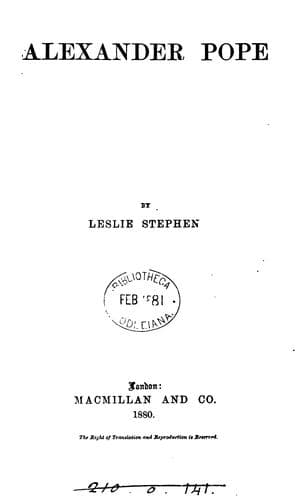
Poets, English -- 18th century -- Biography; Pope, Alexander, 1688-1744
indeed disappointed were we to expect in Pope's letters what we find in
the best specimens of the art: the charm which belongs to a simple
outpouring of friendly feeling in private intercourse; the sweet
playfulness of Cowper, or the grave humour of Gray, or even the sparkle
and brilliance of Walpole's admirable letters. Though Walpole had an eye
to posterity, and has his own mode of affectation, he is for the moment
intent on amusing, and is free from the most annoying blemish in Pope's
writing, the resolution to appear always in full dress, and to mount as
often as possible upon the stilts of moral self-approbation. All this is
obvious to the hasty reader; and yet I must confess my own conviction
that there is scarcely a more interesting volume in the language than
that which contains the correspondence of Swift, Bolingbroke, and Pope.
To enjoy it, indeed, we must not expect to be in sympathy with the
writers. Rather we must adopt the mental attitude of spectators of a
scene of high comedy--the comedy which is dashed with satire and has a
tragical side to it. We are behind the scenes in Vanity Fair, and
listening to the talk of three of its most famous performers, doubting
whether they most deceive each other or the public or themselves. The
secret is an open one for us, now that the illusion which perplexed
contemporaries has worn itself threadbare.
The most impressive letters are undoubtedly those of Swift--the stern
sad humourist, frowning upon the world which has rejected him, and
covering his wrath with an affectation, not of fine sentiment, but of
misanthropy. A soured man prefers to turn his worst side outwards. There
are phrases in his letters which brand themselves upon the memory like
those of no other man; and we are softened into pity as the strong mind
is seen gradually sinking into decay. The two other sharers in the
colloquy are in effective contrast. We see through Bolingbroke's
magnificent self-deceit; the flowing manners of the statesman who,
though the game is lost, is longing for a favourable turn of the card,
but still affects to solace himself with philosophy, and wraps himself
in dignified reflections upon the blessings of retirement, contrast with
Swift's downright avowal of indignant scorn for himself and mankind. And
yet we have a sense of the man's amazing cleverness, and regret that he
has no chance of trying one more fall with his antagonists in the open
arena. Pope's affectation is perhaps the most transparent and the most
gratuitous. His career had been pre-eminently successful; his talents
had found their natural outlet; and he had only to be what he apparently
persuaded himself that he was, to be happy in spite of illness. He is
constantly flourishing his admirable moral sense in our faces, dilating
upon his simplicity, modesty, fidelity to his friends, indifference to
the charms of fame, till we are almost convinced that he has imposed
upon himself. By some strange piece of legerdemain he must surely have
Public-domain text, read in full here on John Shaqi.
Reviews
Reviews
No reviews yet
Be the first to share your thoughts on this work.
Elsewhere in the archive
Join the Discussion
Join the discussion
Sign in to leave a comment or review.
Sign InorCreate an account