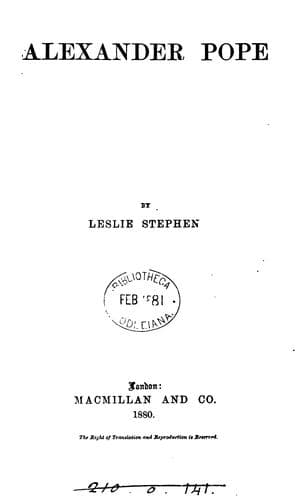
Poets, English -- 18th century -- Biography; Pope, Alexander, 1688-1744
Pope could feel nobly and act honourably when his morbid vanity did not
expose him to some temptation; and I think that in this matter his
attitude was in every way creditable. He showed, indeed, the prejudice
entertained by many of the rationalist divines for the freethinkers who
were a little more outspoken than himself. The deist whose creed was
varnished with Christian phrases, was often bitter against the deist who
rejected the varnish; and Pope put Toland and Tindal into the Dunciad as
scandalous assailants of all religion. From his point of view it was as
wicked to attack any creed as to regard any creed as exclusively true;
and certainly Pope was not disposed to join any party which was hated
and maligned by the mass of the respectable world. For it must be
remembered that, in spite of much that has been said to the contrary,
and in spite of the true tendency of much so-called orthodoxy, the
profession of open dissent from Christian doctrine was then regarded
with extreme disapproval. It might be a fashion, as Butler and others
declare, to talk infidelity in cultivated circles; but a public
promulgation of unbelief was condemned as criminal, and worthy only of
the Grub-street faction. Pope, therefore, was terribly shocked when he
found himself accused of heterodoxy. His poem was at once translated,
and, we are told, spread rapidly in France, where Voltaire and many
inferior writers were introducing the contagion of English freethinking.
A solid Swiss pastor and professor of philosophy, Jean Pierre Crousaz
(1663-1750), undertook the task of refutation, and published an
examination of Pope's philosophy in 1737 and 1738. A serious examination
of this bundle of half-digested opinions was in itself absurd. Some
years afterwards (1751) Pope came under a more powerful critic. The
Berlin Academy of Sciences offered a prize for a similar essay, and
Lessing published a short tract called _Pope ein Metaphysiker_! If any
one cares to see a demonstration that Pope did not understand the system
of Leibnitz, and that the bubble blown by a great philosopher has more
apparent cohesion than that of a half-read poet, he may find a
sufficient statement of the case in Lessing. But Lessing sensibly
protests from the start against the intrusion of such a work into
serious discussion; and that is the only ground which is worth taking in
the matter.
Public-domain text, read in full here on John Shaqi.
Reviews
Reviews
No reviews yet
Be the first to share your thoughts on this work.
Elsewhere in the archive
Join the Discussion
Join the discussion
Sign in to leave a comment or review.
Sign InorCreate an account