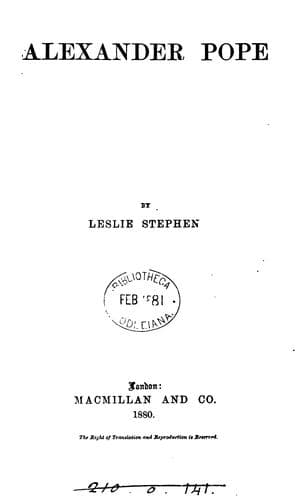
Poets, English -- 18th century -- Biography; Pope, Alexander, 1688-1744
Pope had tried a considerable number of poetical experiments when the
Dunciad appeared, but he had not yet discovered in what direction his
talents could be most efficiently exerted. Bystanders are sometimes
acuter in detecting a man's true forte than the performer himself. In
1722 Atterbury had seen Pope's lines upon Addison, and reported that no
piece of his writing was ever so much sought after. "Since you now
know," he added, "in what direction your strength lies, I hope you will
not suffer that talent to be unemployed." Atterbury seems to have been
rather fond of giving advice to Pope, and puts on a decidedly pedagogic
air when writing to him. The present suggestion was more likely to fall
on willing ears than another made shortly before their final separation.
Atterbury then presented Pope with a Bible, and recommended him to study
its pages. If Pope had taken to heart some of St. Paul's exhortations to
Christian charity, he would scarcely have published his lines upon
Addison, and English literature would have lost some of its most
brilliant pages.
Satire of the kind represented by those lines was so obviously adapted
to Pope's peculiar talent, that we rather wonder at his having taken to
it seriously at a comparatively late period, and even then having
drifted into it by accident rather than by deliberate adoption. He had
aimed, as has been said, at being a philosophic and didactic poet. The
Essay on Man formed part of a much larger plan, of which two or three
fragmentary sketches are given by Spence.[24] Bolingbroke and Pope wrote
to Swift in November, 1729, about a scheme then in course of execution.
Bolingbroke declares that Pope is now exerting what was eminently and
peculiarly his talents, above all writers, living or dead, without
excepting Horace; whilst Pope explained that this was a "system of
ethics in the Horatian way." The language seems to apply best to the
poems afterwards called the Ethic Epistles, though, at this time, Pope,
perhaps, had not a very clear plan in his head, and was working at
different parts simultaneously. The Essay on Man, his most distinct
scheme, was to form the opening book of his poem. Three others were to
treat of knowledge and its limits, of government--ecclesiastical and
civil--and of morality. The last book itself involved an elaborate plan.
There were to be three epistles about each cardinal virtue--one, for
example, upon avarice; another on the contrary extreme of prodigality;
and a third, upon the judicious mean of a moderate use of riches. Pope
told Spence that he had dropped the plan chiefly because his third book
would have provoked every Church on the face of the earth, and he did
not care for always being in boiling water. The scheme, however, was far
too wide and too systematic for Pope's powers. His spasmodic energy
enabled him only to fill up corners of the canvas, and from what he did,
it is sufficiently evident that his classification would have been
Public-domain text, read in full here on John Shaqi.
Reviews
Reviews
No reviews yet
Be the first to share your thoughts on this work.
Elsewhere in the archive
Join the Discussion
Join the discussion
Sign in to leave a comment or review.
Sign InorCreate an account