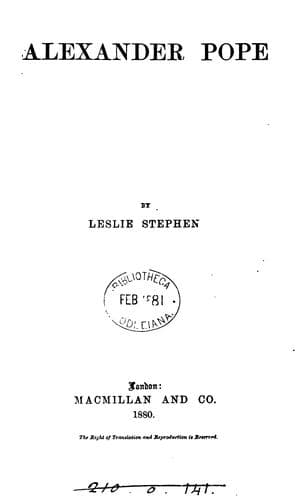
Poets, English -- 18th century -- Biography; Pope, Alexander, 1688-1744
* * * * *
Ye reverend atheists. (Friend) Scandal! name them! who?
(Pope) Why, that's the thing you bade me not to do.
Who starved a sister, who forswore a debt,
I never named; the town's inquiring yet.
The pois'ning dame-- (F.) You mean-- (P.) I don't. (F.) You
do.
(P.) See, now, I keep the secret, and not you!
It must in fact be admitted that from the purely artistic point of view,
Pope is right. Prosaic commentators are always asking, Who is meant by a
poet, as though a poem were a legal document. It may be interesting, for
various purposes, to know who was in the writer's mind, or what fact
suggested the general picture. But we have no right to look outside the
poem itself, or to infer anything not within the four corners of the
statement. It matters not for such purposes whether there was, or was
not, any real person corresponding to Sir Balaam, to whom his wife said,
when he was enriched by Cornish wreckers, "live like yourself,"
When lo! two puddings smoked upon the board,
in place of the previous one on Sabbath days. Nor does it even matter
whether Atticus meant Addison, or Sappho Lady Mary. The satire is
equally good, whether its objects are mere names or realities.
But the moral question is quite distinct. In that case we must ask
whether Pope used words calculated or intended to fix an imputation upon
particular people. Whether he did it in prose or verse, the offence was
the same. In many cases he gives real names, and in many others gives
unmistakable indications, which must have fixed his satire to particular
people. If he had written Addison for Atticus (as he did at first), or
Lady Mary for Sappho, or Halifax for Bufo, the insinuation could not
have been clearer. His attempt to evade his responsibility was a mere
equivocation--a device which he seems to have preferred to direct lying.
The character of Bufo might be equally suitable to others; but no
reasonable man could doubt that every one would fix it upon Halifax. In
some cases--possibly in that of Chandos--he may have thought that his
language was too general to apply, and occasionally it seems that he
sometimes tried to evade consequences by adding some inconsistent
characteristic to his portraits.
Public-domain text, read in full here on John Shaqi.
Reviews
Reviews
No reviews yet
Be the first to share your thoughts on this work.
Elsewhere in the archive
Join the Discussion
Join the discussion
Sign in to leave a comment or review.
Sign InorCreate an account