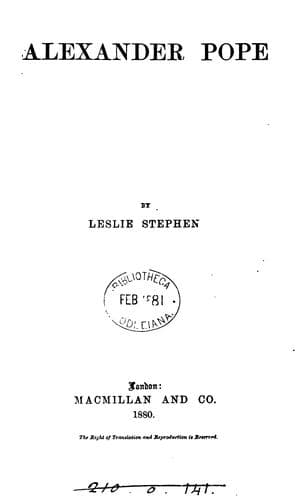
Poets, English -- 18th century -- Biography; Pope, Alexander, 1688-1744
His tendency to didactic platitudes is at least out of place
in such cases, and his dread of vulgarity and quaintness, with his
genuine feeling for breadth of effect, frequently enables him to be
really dignified and impressive. It will perhaps be sufficient
illustration of these qualities if I conclude these remarks by giving
his translation of Hector's speech to Polydamas in the twelfth book,
with its famous +eis oionos aristos amynesthai peri patres+.
To him then Hector with disdain return'd;
(Fierce as he spoke, his eyes with fury burn'd)--
Are these the faithful counsels of thy tongue?
Thy will is partial, not thy reason wrong;
Or if the purpose of thy heart thou sent,
Sure Heaven resumes the little sense it lent--
What coward counsels would thy madness move
Against the word, the will reveal'd of Jove?
The leading sign, the irrevocable nod
And happy thunders of the favouring God?
These shall I slight? And guide my wavering mind
By wand'ring birds that flit with every wind?
Ye vagrants of the sky! your wings extend
Or where the suns arise or where descend;
To right or left, unheeded take your way,
While I the dictates of high heaven obey.
Without a sigh his sword the brave man draws,
And asks no omen but his country's cause.
But why should'st thou suspect the war's success?
None fears it more, as none promotes it less.
Tho' all our ships amid yon ships expire,
Trust thy own cowardice to escape the fire.
Troy and her sons may find a general grave,
But thou canst live, for thou canst be a slave.
Yet should the fears that wary mind suggests
Spread their cold poison through our soldiers' breasts,
My javelin can revenge so base a part,
And free the soul that quivers in thy heart.
Public-domain text, read in full here on John Shaqi.
Reviews
Reviews
No reviews yet
Be the first to share your thoughts on this work.
Join the Discussion
Join the discussion
Sign in to leave a comment or review.
Sign InorCreate an account