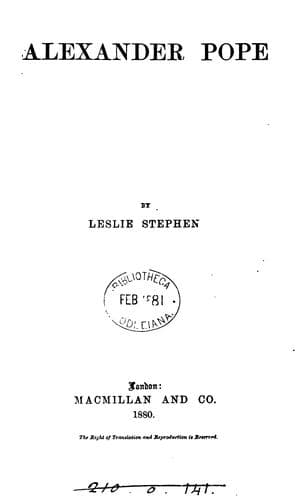
Poets, English -- 18th century -- Biography; Pope, Alexander, 1688-1744
Pope's constitutional irritability kept him constantly on the wing.
Though little interested in politics, he liked to be on the edge of any
political commotion. He appeared in London on the death of Queen
Caroline, in 1737; and Bathurst remarked that "he was as sure to be
there in a bustle as a porpoise in a storm." "Our friend Pope," said
Jervas not long before, "is off and on, here and there, everywhere and
nowhere, _a son ordinaire_, and, therefore as well as we can hope for a
carcase so crazy." The Twickenham villa, though nominally dedicated to
repose, became of course a centre of attraction for the interviewers of
the day. The opening lines of the Prologue to the Satires give a
vivacious description of the crowds of authors who rushed to "Twitnam,"
to obtain his patronage or countenance, in a day when editors were not
the natural scapegoats of such aspirants.
What walls can guard me, or what shades can hide?
They pierce my thickets, through my grot they glide;
By land, by water, they renew the charge;
They stop the chariot and they board the barge:
No place is sacred, not the church is free,
E'en Sunday shines no Sabbath-day to me.
And even at an earlier period he occasionally retreated from the bustle
to find time for his Homer. Lord Harcourt, the Chancellor in the last
years of Queen Anne, allowed him to take up his residence in his old
house of Stanton Harcourt, in Oxfordshire. He inscribed on a pane of
glass in an upper room, "In the year 1718 Alexander Pope finished here
the fifth volume of Homer." In his earlier days he was often rambling
about on horseback. A letter from Jervas gives the plan of one such
jaunt (in 1715) with Arbuthnot and Disney for companions. Arbuthnot is
to be commander-in-chief, and allows only a shirt and a cravat to be
carried in each traveller's pocket. They are to make a moderate journey
each day, and stay at the houses of various friends, ending ultimately
at Bath. Another letter of about the same date describes a ride to
Oxford, in which Pope is overtaken by his publisher, Lintot, who lets
him into various secrets of the trade, and proposes that Pope should
turn an ode of Horace whilst sitting under the trees to rest. "Lord, if
you pleased, what a clever miscellany might you make at leisure hours!"
exclaims the man of business; and though Pope laughed at the advice, we
might fancy that he took it to heart. He always had bits of verse on the
anvil, ready to be hammered and polished at any moment. But even Pope
could not be always writing, and the mere mention of these rambles
suggests pleasant lounging through old-world country lanes of the quiet
century. We think of the road-side life seen by Parson Adams or Humphry
Clinker, and of which Mr. Borrow caught the last glimpse when dwelling
in the tents of the Romany. In later days Pope had to put his "crazy
carcase" into a carriage, and occasionally came in for less pleasant
experiences.
Public-domain text, read in full here on John Shaqi.
Reviews
Reviews
No reviews yet
Be the first to share your thoughts on this work.
Elsewhere in the archive
Join the Discussion
Join the discussion
Sign in to leave a comment or review.
Sign InorCreate an account