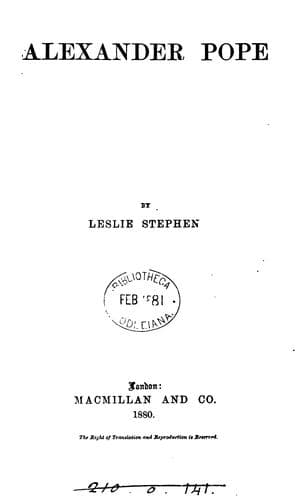
Poets, English -- 18th century -- Biography; Pope, Alexander, 1688-1744
Whilst driving home one night from Dawley, in
Bolingbroke's carriage and six, he was upset in a stream. He escaped
drowning, though the water was "up to the knots of his periwig," but he
was so cut by the broken glass that he nearly lost the use of his right
hand. On another occasion Spence was delighted by the sudden appearance
of the poet at Oxford, "dreadfully fatigued;" he had good-naturedly lent
his own chariot to a lady who had been hurt in an upset, and had walked
three miles to Oxford on a sultry day.
A man of such brilliant wit, familiar with so many social circles,
should have been a charming companion. It must, however, be admitted
that the accounts which have come down to us do not confirm such
preconceived impressions. Like his great rival, Addison, though for
other reasons, he was generally disappointing in society. Pope, as may
be guessed from Spence's reports, had a large fund of interesting
literary talk, such as youthful aspirants to fame would be delighted to
receive with reverence; he had the reputation for telling anecdotes
skilfully, and we may suppose that when he felt at ease, with a
respectful and safe companion, he could do himself justice. But he must
have been very trying to his hosts. He could seldom lay aside his
self-consciousness sufficiently to write an easy letter; and the same
fault probably spoilt his conversation. Swift complains of him as a
silent and inattentive companion. He went to sleep at his own table,
says Johnson, when the Prince of Wales was talking poetry to
him--certainly a severe trial. He would, we may guess, be silent till he
had something to say worthy of the great Pope, and would then doubt
whether it was not wise to treasure it up for preservation in a couplet.
His sister declared that she had never seen him laugh heartily; and
Spence, who records the saying, is surprised, because Pope was said to
have been very lively in his youth; but admits that in later years he
never went beyond a "particular easy smile." A hearty laugh would have
sounded strangely from the touchy, moody, intriguing little man, who
could "hardly drink tea without a stratagem." His sensitiveness, indeed,
appearing by his often weeping when he read moving passages; but we can
hardly imagine him as ever capable of genial self-abandonment.
Public-domain text, read in full here on John Shaqi.
Reviews
Reviews
No reviews yet
Be the first to share your thoughts on this work.
Elsewhere in the archive
Join the Discussion
Join the discussion
Sign in to leave a comment or review.
Sign InorCreate an account