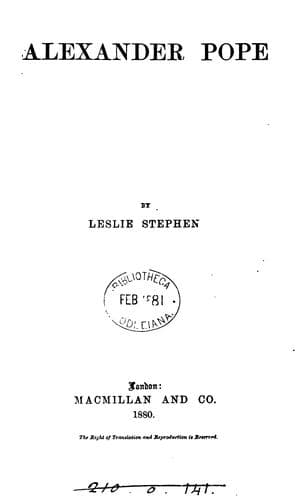
Poets, English -- 18th century -- Biography; Pope, Alexander, 1688-1744
an expression of virulent hatred. He was like a dirty boy who throws mud
from an ambush, and declares that he did not see the victim
bespattered.[11]
A bitter and humiliating quarrel followed. Lord Hervey, who had been
described as "Lord Fanny," in the same satire, joined with his friend,
Lady Mary, in writing lampoons upon Pope. The best known was a copy of
verses, chiefly, if not exclusively by Lady Mary, in which Pope is
brutally taunted with the personal deformities of his "wretched little
carcass," which, it seems, are the only cause of his being "unwhipt,
unblanketed, unkicked." One verse seems to have stung him more deeply,
which says that his "crabbed numbers" are
Hard as his heart and as his birth obscure.
To this and other assaults Pope replied by a long letter, suppressed,
however, for the time, which, as Johnson says, exhibits to later readers
"nothing but tedious malignity," and is, in fact, a careful raking
together of everything likely to give pain to his victim. It was not
published till 1751, when both Pope and Hervey were dead. In his later
writings he made references to Sappho, which fixed the name upon her,
and amongst other pleasant insinuations, speaks of a weakness which she
shared with Dr. Johnson,--an inadequate appreciation of clean linen.
More malignant accusations are implied both in his acknowledged and
anonymous writings. The most ferocious of all his assaults, however, is
the character of Sporus, that is Lord Hervey, in the epistle to
Arbuthnot, where he seems to be actually screaming with malignant fury.
He returns the taunts as to effeminacy, and calls his adversary a "mere
white curd of asses' milk,"--an innocent drink, which he was himself in
the habit of consuming.
We turn gladly from these miserable hostilities, disgraceful to all
concerned. Were any excuse available for Pope, it would be in the
brutality of taunts, coming not only from rough dwellers in Grub Street,
but from the most polished representatives of the highest classes, upon
personal defects, which the most ungenerous assailant might surely have
spared. But it must also be granted that Pope was neither the last to
give provocation, nor at all inclined to refrain from the use of
poisoned weapons.
Public-domain text, read in full here on John Shaqi.
Reviews
Reviews
No reviews yet
Be the first to share your thoughts on this work.
Elsewhere in the archive
Join the Discussion
Join the discussion
Sign in to leave a comment or review.
Sign InorCreate an account