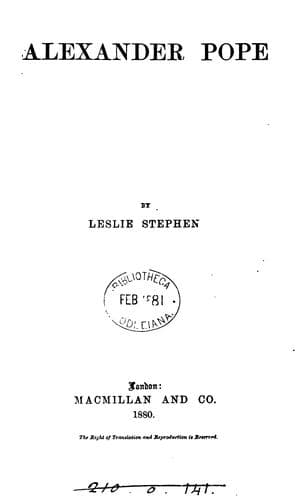
Poets, English -- 18th century -- Biography; Pope, Alexander, 1688-1744
[11] Another couplet in the second book of the Dunciad about "hapless
Monsieur" and "Lady Maries," was also applied at the time to Lady M. W.
Montagu: and Pope in a later note affects to deny, thus really pointing
the allusion. But the obvious meaning of the whole passage is that
"duchesses and Lady Maries" might be personated by abandoned women,
which would certainly be unpleasant for them, but does not imply any
imputation upon their character. If Lady Mary was really the author of a
"Pop upon Pope"--a story of Pope's supposed whipping in the vein of his
own attack upon Dennis, she already considered him as the author of some
scandal. The line in the Dunciad was taken to allude to a story about a
M. Remond which has been fully cleared up.
[12] The statements as to the date of the acquaintance are
contradictory. Martha told Spence that she first knew Pope as a "very
little girl," but added that it was after the publication of the Essay
on Criticism, when she was twenty-one; and at another time, that it was
after he had begun the Iliad, which was later than part of the published
correspondence.
CHAPTER V.
THE WAR WITH THE DUNCES.
In the Dunciad, published soon after the Odyssey, Pope laments ten years
spent as a commentator and translator. He was not without compensation.
The drudgery--for the latter part of his task must have been felt as
drudgery--once over, he found himself in a thoroughly independent
position, still on the right side of forty, and able to devote his
talents to any task which might please him. The task which he actually
chose was not calculated to promote his happiness. We must look back to
an earlier period to explain its history. During the last years of Queen
Anne, Pope had belonged to a "little senate" in which Swift was the
chief figure. Though Swift did not exercise either so gentle or so
imperial a sway as Addison, the cohesion between the more independent
members of this rival clique was strong and lasting. They amused
themselves by projecting the Scriblerus Club, a body which never had, it
would seem, any definite organization, but was held to exist for the
prosecution of a design never fully executed. Martinus Scriblerus was
the name of an imaginary pedant--a precursor and relative of Dr.
Dryasdust--whose memoirs and works were to form a satire upon stupidity
in the guise of learning. The various members of the club were to share
in the compilation; and if such joint-stock undertakings were
practicable in literature, it would be difficult to collect a more
brilliant set of contributors. After Swift--the terrible humourist of
whom we can hardly think without a mixture of horror and compassion--the
chief members were Atterbury, Arbuthnot, Gay, Parnell, and Pope himself.
Parnell, an amiable man, died in 1717, leaving works which were edited
by Pope in 1722. Atterbury, a potential Wolsey or Laud born in an
uncongenial period, was a man of fine literary taste--a warm admirer of
Public-domain text, read in full here on John Shaqi.
Reviews
Reviews
No reviews yet
Be the first to share your thoughts on this work.
Elsewhere in the archive
Join the Discussion
Join the discussion
Sign in to leave a comment or review.
Sign InorCreate an account