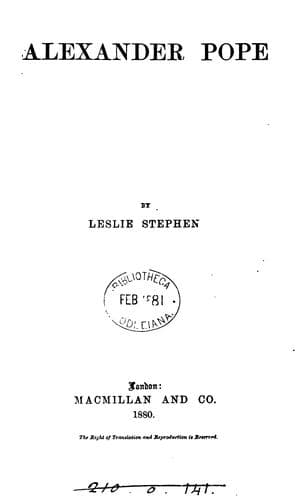
Poets, English -- 18th century -- Biography; Pope, Alexander, 1688-1744
You think this cruel? Take it for a rule,
No creature smarts so little as a fool.
To reconcile us to such laughter, it should have a more genial tone than
Pope could find in his nature. We ought to feel, and we certainly do not
feel, that after the joke has been fired off there should be some
possibility of reconciliation, or, at least, we should find some
recognition of the fact that the victims are not to be hated simply
because they were not such clever fellows as Pope. There is something
cruel in Pope's laughter, as in Swift's. The missiles are not mere
filth, but are weighted with hard materials that bruise and mangle. He
professes that his enemies were the first aggressors, a plea which can
be only true in part; and he defends himself, feebly enough, against the
obvious charge that he has ridiculed men for being obscure, poor, and
stupid--faults not to be amended by satire, nor rightfully provocative
of enmity. In fact, Pope knows in his better moments that a man is not
necessarily wicked because he sleeps on a bulk, or writes verses in a
garret; but he also knows that to mention those facts will give his
enemies pain, and he cannot refrain from the use of so handy a weapon.
Such faults make one half ashamed of confessing to reading the Dunciad
with pleasure; and yet it is frequently written with such force and
freedom that we half pardon the cruel little persecutor, and admire the
vigour with which he throws down the gauntlet to the natural enemies of
genius. The Dunciad is modelled upon the Mac Flecknoe, in which Dryden
celebrates the appointment of Elkanah Shadwell to succeed Flecknoe as
monarch of the realms of Dulness, and describes the coronation
ceremonies. Pope imitates many passages, and adopts the general design.
Though he does not equal the vigour of some of Dryden's lines, and wages
war in a more ungenerous spirit, the Dunciad has a wider scope than its
original, and shows Pope's command of his weapons in occasional
felicitous phrases, in the vigour of the versification, and in the
general sense of form and clear presentation of the scene imagined. For
a successor to the great empire of dulness he chose (in the original
form of the poem) the unlucky Theobald, a writer to whom the merit is
attributed of having first illustrated Shakspeare by a study of the
contemporary literature. In doing this he had fallen foul of Pope, who
could claim no such merit for his own editorial work, and Pope therefore
regarded him as a grovelling antiquarian. As such, he was a fit
pretender enough to the throne once occupied by Settle. The Dunciad
begins by a spirited description of the goddess brooding in her cell
upon the eve of a Lord Mayor's day, when the proud scene was o'er,
But lived in Settle's numbers one day more.
Public-domain text, read in full here on John Shaqi.
Reviews
Reviews
No reviews yet
Be the first to share your thoughts on this work.
Elsewhere in the archive
Join the Discussion
Join the discussion
Sign in to leave a comment or review.
Sign InorCreate an account