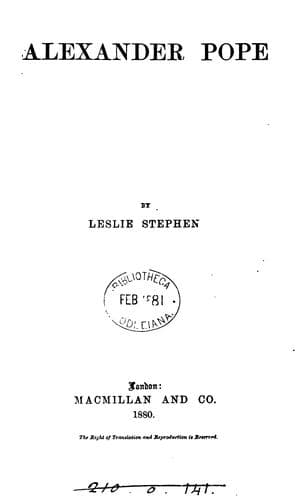
Poets, English -- 18th century -- Biography; Pope, Alexander, 1688-1744
Dulness is sacred in a sound divine.
The games are concluded in the second book; and in the third the hero,
sleeping in the Temple of Dulness, meets in a vision the ghost of
Settle, who reveals to him the future of his empire; tells how dulness
is to overspread the world, and revive the triumphs of Goths and monks;
how the hated Dennis, and Gildon, and others, are to overwhelm scorners,
and set up at court, and preside over arts and sciences, though a fit of
temporary sanity causes him to give a warning to the deists--
But learn ye dunces! not to scorn your God--
and how posterity is to witness the decay of the stage, under a deluge
of silly farce, opera, and sensation dramas; how bad architects are to
deface the works of Wren and Inigo Jones; whilst the universities and
public schools are to be given up to games and idleness, and the birch
is to be abolished.
Fragments of the prediction have not been entirely falsified, though the
last couplet intimates a hope.
Enough! enough! the raptured monarch cries,
And through the ivory gate the vision flies.
The Dunciad was thus a declaration of war against the whole tribe of
scribblers; and, like other such declarations, it brought more
consequences than Pope foresaw. It introduced Pope to a very dangerous
line of conduct. Swift had written to Pope in 1725: "Take care that the
bad poets do not outwit you, as they have served the good ones in every
age, whom they have provoked to transmit their names to posterity;" and
the Dunciad has been generally censured from Swift's point of view.
Satire, it is said, is wasted upon such insignificant persons. To this
Pope might have replied, with some plausibility, that the interest of
satire must always depend upon its internal qualities, not upon our
independent knowledge of its object. Though Gildon and Arnall are
forgotten, the type "dunce" is eternal. The warfare, however, was
demoralizing in another sense. Whatever may have been the injustice of
Pope's attacks upon individuals, the moral standard of the Grub Street
population was far from exalted. The poor scribbler had too many
temptations to sell himself, and to evade the occasional severity of the
laws of libel by humiliating contrivances. Moreover, the uncertainty of
the law of copyright encouraged the lower class of booksellers to
undertake all kinds of piratical enterprises, and to trade in various
ways upon the fame of well-known authors, by attributing trash to them,
or purloining and publishing what the authors would have suppressed.
Dublin was to London what New York is now, and successful books were at
once reproduced in Ireland. Thus the lower strata of the literary class
frequently practised with impunity all manner of more or less
discreditable trickery, and Pope, with his morbid propensity for
mystification, was only too apt a pupil in such arts. Though the tone of
his public utterances was always of the loftiest, he was like a
Public-domain text, read in full here on John Shaqi.
Reviews
Reviews
No reviews yet
Be the first to share your thoughts on this work.
Elsewhere in the archive
Join the Discussion
Join the discussion
Sign in to leave a comment or review.
Sign InorCreate an account