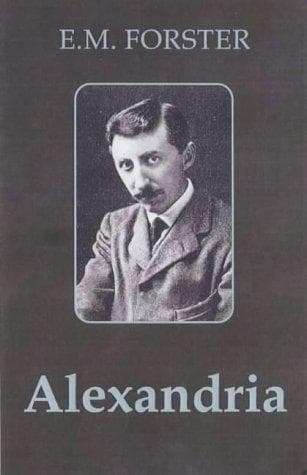
Alexandria: A History and a GuideForster, E. M. (Edward Morgan)
History
Alexandria: A History and a Guide
Forster, E. M. (Edward Morgan)
Alexandria (Egypt) -- Guidebooks; Alexandria (Egypt) -- History
AT BACK OF GARDEN: Granite group of Rameses II and his
daughter—headless. From Aboukir. Against the wall behind: colossal green
granite head of Antony as Osiris. From near Nouzha (p. 157). The
companion head of Cleopatra as Isis is in Belgium.
SOUTH GARDEN: Two reconstructed tombs from the Chatby Necropolis (p.
164). The first (in the corner) is remarkable. The sarcophagus imitates
a bed with cushions each end. The chamber where it stands was once
preceded by a long vestibule for the mourners (as in the Anfouchi tombs,
p. 126). The date 3rd. cent. B.C. The second tomb has a shell vault
niche (like Kom es Chogafa, p. 148).
* * * * *
The Rue Rosette continues and at last issues from between houses. Here,
ever since its foundation, the city has ended; in Ptolemaic times the
Gate of the Sun or Canopic Gate stood here, in Arab times the Rosetta
Gate. The Public Gardens (left and right) follow the line of the Arab
walls (see p. 81 and Section IV). The tramway to Nouzha crosses the
route. The road continues under another name to Sidi Gaber (Section V),
thence to Ramleh, and to Aboukir (Section VII). It is a good road and
well planted; but terribly straight, like all roads that the Ancients
have planned.
SECTION II.
-------
FROM THE SQUARE TO RAS-EL-TIN.
ROUTE:—By the Rue de France and Rue Ras-el-Tin to Ras-el-Tin promontory;
returning to the Square by Anfouchi Bay and the Eastern Harbour—the
“Circular” Tram (Green Triangle) runs along the Quays.
CHIEF POINTS OF INTEREST:—Terbana and Chorbagi Mosques; Mosque of Abou
el Abbas; Anfouchi Catacombs; Ras-el-Tin Palace; Prehistoric Harbour;
Fort Kait Bey; New Quays.
We start from the north-west corner of the Square. The Rue de France
traverses the “Turkish Town” (p. 84), which was built in the 17th and
18th cents. on the spit of land that had accreted round the ruined
Ptolemaic dyke (p. 10). Its bazaars and Mosques are on a small scale,
for the city was then at her feeblest. But the district is picturesque
and, especially at evening, full of gentle charm. The best way of seeing
it is to wander aimlessly about.
In the Rue de France:—Right: Rue Pirona. Built into the wall at its
entrance are fragments of Egyptian sculpture, the lion-headed goddess
Sekhet, &c. The road opens into a picturesque little square which
contains a former Native Tribunal, and a building (No. 4) that has a
carved gateway and a tranquil court yard with antique columns.
In the roads to the left of the Rue de France are some Mosques:—
_Mosque of Sheikh Ibrahim Pacha_, off the south-west corner of the
Square; big ugly building with red and yellow minaret.
Public-domain text, read in full here on John Shaqi.
Reviews
Reviews
No reviews yet
Be the first to share your thoughts on this work.
Elsewhere in the archive
Join the Discussion
Join the discussion
Sign in to leave a comment or review.
Sign InorCreate an account